
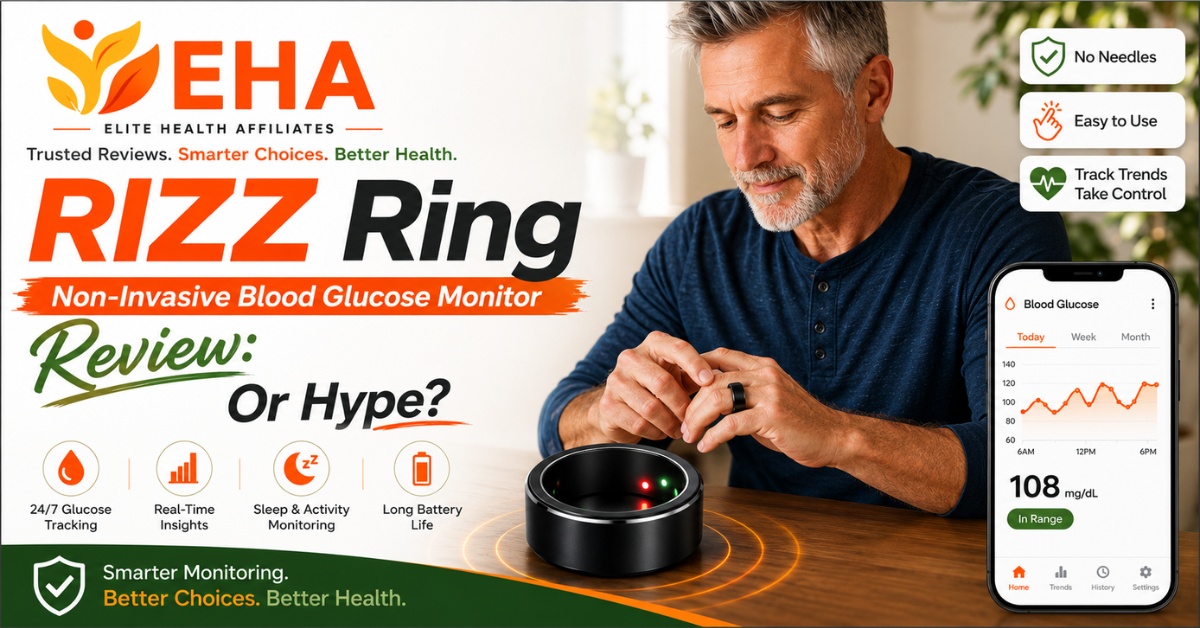
The RIZZ Ring is a non-invasive blood glucose monitor that claims to track glucose trends without finger pricks, implanted sensors, or adhesive patches. It almost sounds too good to be true. Marketed as the “world’s first non-invasive CGM ring,” it promises real-time glucose tracking along with sleep, stress, heart rate, oxygen levels, and more — all from a device worn on your finger.
For anyone managing blood sugar, the appeal is obvious. Traditional continuous glucose monitors (CGMs) require sensors inserted under the skin. Standard blood sugar meters still require finger sticks. A ring that eliminates both would represent a major shift in glucose monitoring technology. But bold claims require careful evaluation.
So, is the RIZZ Ring worth the investment? Short answer: Yes—for the right person. If your goal is a comfortable, non-invasive wearable that helps you follow glucose trends alongside sleep, heart rate, stress, and activity, the RIZZ Ring offers an interesting approach. Just keep in mind that it’s designed as a wellness device rather than a replacement for a medical-grade glucose monitor.
In this RIZZ Ring review, we’ll take a closer look at how the device claims to work, what we found during our hands-on evaluation under RN supervision, and whether it’s a legitimate option for people seeking a non-invasive blood glucose monitor—or if its limitations outweigh its convenience.
This post contains affiliate links. If you purchase through them, we may earn a small commission at no extra cost to you.
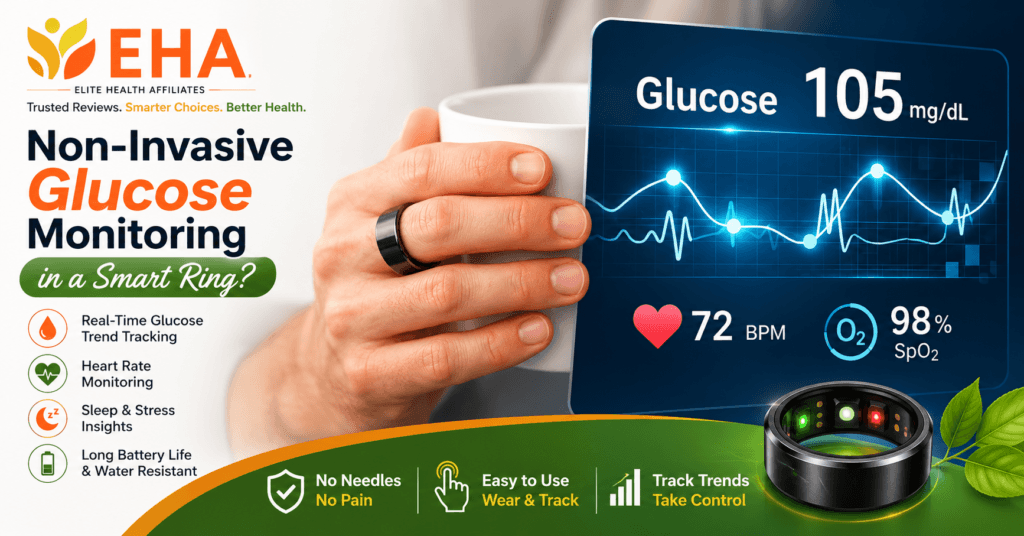
For everyday tracking and wearable convenience, the RIZZ Ring offers a simple and approachable way to monitor your data.
See features, pricing, and how it works on the official site.
Table of Contents
How Does the RIZZ Ring Claim to Measure Glucose Without Sensors?
The RIZZ Ring positions itself as a non-invasive blood glucose monitor that eliminates the need for implanted sensors or finger pricks. Instead of inserting a filament under the skin like traditional continuous glucose monitors (CGMs), the company says the ring uses advanced biosensing technology to analyze changes in the body through the skin.
According to its marketing, the device collects biometric data such as heart rate, blood oxygen, skin temperature, and other physiological signals. By combining these measurements, the RIZZ Ring aims to estimate glucose trends in real time without breaking the skin or requiring disposable sensors.
If that technology continues to evolve, it could represent a significant step forward in wearable health monitoring. Current FDA-cleared continuous glucose monitors (CGMs) rely on interstitial fluid measurements using a sensor placed just beneath the skin. A device capable of delivering meaningful glucose insights externally would offer a more comfortable alternative for many users.
The key question, however, is whether the technology behind the RIZZ Ring has the clinical validation and regulatory backing needed to support those claims. That’s where it’s important to separate the promise of the technology from the evidence currently available.
Is the RIZZ Ring FDA Approved or Clinically Validated?
When evaluating any non-invasive blood glucose monitor, regulatory approval and clinical validation are critical. In the United States, devices that measure glucose for medical decision-making typically require clearance or approval from the FDA. This helps ensure the technology has been tested for accuracy, safety, and reliability.
At the time of writing, there is no publicly available evidence that the RIZZ Ring has received FDA clearance as a medical-grade continuous glucose monitor (CGM). That distinction matters. Devices cleared for glucose monitoring must meet strict accuracy standards, often measured against laboratory blood glucose testing.
It’s also important to differentiate between a wellness device and a medical device. Many wearable products can legally track general wellness metrics like heart rate, sleep, or activity without FDA approval. However, devices intended for real-time glucose monitoring fall into a much more highly regulated category.
While the concept behind the RIZZ Ring is certainly intriguing, there are currently no published clinical studies, peer-reviewed research, or regulatory documentation publicly available to verify its glucose-monitoring claims. Until more validation becomes available, it’s best to view the RIZZ Ring as a wellness wearable rather than a replacement for a clinically validated continuous glucose monitor (CGM).
For individuals managing diabetes or prediabetes, accuracy is more than a convenience—it’s essential. Understanding the difference between a wellness wearable and a clinically validated non-invasive blood glucose monitor can help you choose the right device for your specific needs.
How We Tested the RIZZ Ring and What We Found (Under RN Supervision)
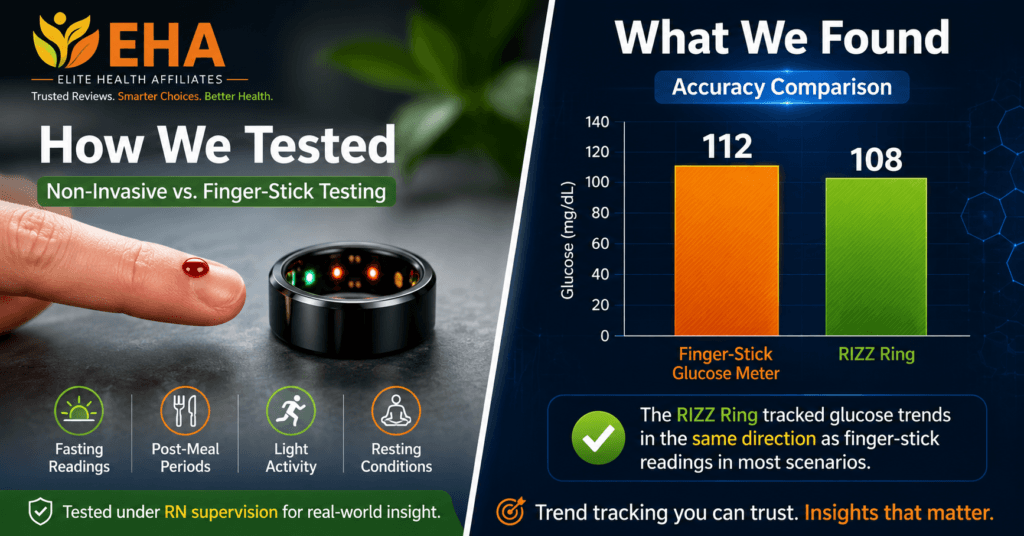
To better understand how the RIZZ Ring performs, we evaluated it alongside a standard finger-stick glucose meter under the supervision of a Registered Nurse (RN). Our goal wasn’t to disprove the technology—it was to see how this emerging wearable compares with more traditional approaches to blood sugar monitoring.
Our testing included:
- Fasting readings
- Post-meal periods
- Light activity
- Resting conditions
Throughout our evaluation, the RIZZ Ring generally reflected changes in glucose direction. When blood sugar increased or decreased, the ring often indicated a similar upward or downward trend. For users interested in observing overall patterns rather than relying solely on individual readings, this type of trend tracking can provide useful day-to-day insight.
Like many emerging wellness wearables, however, the exact numerical readings did not consistently match our finger-stick glucose meter. That’s an important distinction. Clinically validated continuous glucose monitors (CGMs) are specifically engineered and tested for medical accuracy, while devices like the RIZZ Ring are better viewed as wellness tools designed to help users follow trends over time.
If your primary goal is understanding how meals, activity, or daily habits affect your glucose patterns, the RIZZ Ring offers a convenient, non-invasive way to monitor those changes. However, if you need precise glucose readings for diabetes management or treatment decisions, a clinically validated glucose monitor remains the better choice.
What This Means for Consumers
The idea of a comfortable, wearable non-invasive blood glucose monitor is understandably appealing. Eliminating finger pricks and implanted sensors would represent a meaningful advancement in glucose monitoring technology, and that’s exactly why devices like the RIZZ Ring have generated so much interest.
The key is understanding what the RIZZ Ring is designed to do. Rather than serving as a replacement for a clinically validated glucose monitor, it’s better viewed as a wellness wearable that helps you observe glucose trends alongside other important health metrics like sleep, heart rate, stress, and activity.
For many users, that’s more than enough. If your goal is to gain a better understanding of how your daily habits may influence your overall wellness, the RIZZ Ring offers a comfortable, non-invasive way to track those patterns without finger pricks or wearable patches.
If, however, you need precise glucose readings for diabetes management or treatment decisions, a clinically validated glucose monitor remains the better choice. Choosing the right device ultimately comes down to your personal health goals and the level of accuracy your situation requires.
RIZZ Ring Pros and Cons
Pros
- Completely non-invasive design with no finger pricks or implanted sensors
- Combines glucose trend tracking with sleep, stress, heart rate, and activity monitoring
- Comfortable ring-style wearable for all-day use
- No adhesive patches or external transmitters
- Ideal for users who value convenience, comfort, and overall wellness insights
Cons
- Limited publicly available clinical validation data at this time
- No published accuracy metrics (such as MARD values commonly used in CGM testing)
- Designed as a wellness wearable rather than an FDA-cleared medical glucose monitor
- Best suited for tracking glucose trends instead of making medical treatment decisions
Who Is the RIZZ Ring Best For?
The RIZZ Ring is best suited for people who want an easier, more comfortable way to gain insight into their health without relying on finger pricks or wearable patches. Rather than replacing a medical glucose monitor, it’s designed for users who value convenience and want to follow overall wellness trends in a familiar smart ring form.
The RIZZ Ring may be an excellent fit for:
- Health-conscious individuals who want to observe how daily habits may influence glucose trends
- People interested in improving their nutrition, exercise, or overall wellness
- Biohacking enthusiasts who enjoy exploring emerging wearable technology
- Users who want to combine glucose trend tracking with sleep, stress, heart rate, and activity monitoring in one device
- Anyone who prefers the comfort and simplicity of a ring instead of adhesive glucose sensor patches
Because it looks and feels like a traditional smart ring, the RIZZ Ring can be worn comfortably throughout the day without drawing attention. For many users, that convenience makes it easier to build consistent health-tracking habits over time.
If you depend on precise glucose readings for diabetes management or medication decisions, a clinically validated glucose monitor remains the better choice. However, if your goal is to better understand overall glucose trends and how your lifestyle affects them, the RIZZ Ring offers a comfortable, non-invasive alternative worth considering.
What If You’re Already Using Libre?
If you’re already using a Libre sensor, you already have access to one of the most trusted systems for continuous glucose monitoring. The RIZZ Ring isn’t intended to replace that level of medical-grade glucose tracking.
Instead, the RIZZ Ring appeals to a different type of user. It’s designed for people who want a comfortable, non-invasive wearable that combines glucose trend monitoring with sleep, stress, heart rate, blood oxygen, and activity tracking in a single smart ring.
If you’re satisfied with the accuracy and features of your Libre system, there’s little reason to switch. However, if you’re simply curious about wearable wellness technology or want a less intrusive way to monitor overall glucose trends, the RIZZ Ring may be worth exploring.
If you’d like to learn more about getting the most from your Libre system, be sure to check out our complete Libre guide.

Frequently Asked Questions
Is the RIZZ Ring a non-invasive blood glucose monitor?
The RIZZ Ring is marketed as a non-invasive blood glucose monitor because it does not require finger pricks or implanted sensors. Instead, it uses wearable biosensing technology to estimate glucose trends alongside other health metrics. It’s best viewed as a wellness wearable designed to provide insight into overall patterns rather than replace a clinically validated glucose monitor.
Does the RIZZ Ring replace a traditional CGM?
No. The RIZZ Ring is not positioned as an FDA-cleared continuous glucose monitor (CGM). Traditional CGMs use a small sensor inserted beneath the skin and are clinically validated for medical use. If you depend on medical-grade accuracy for diabetes management, a traditional CGM remains the better choice.
Is the RIZZ Ring FDA approved?
At the time of writing, there is no publicly available documentation confirming FDA clearance for the RIZZ Ring as a medical glucose monitoring device. Like many wellness wearables, it is designed to provide health insights rather than serve as a clinically validated medical device.
How does the RIZZ Ring measure glucose without finger pricks?
According to the company’s marketing, the RIZZ Ring analyzes biometric signals collected through the skin to estimate glucose trends. These signals may include heart rate, blood oxygen, skin temperature, and other physiological measurements. The company’s proprietary technology has not yet been supported by publicly available clinical studies.
Who should consider the RIZZ Ring?
The RIZZ Ring is a good fit for people who want a comfortable, non-invasive way to monitor glucose trends alongside sleep, stress, heart rate, and activity. It’s especially appealing to users who value convenience and prefer a ring over traditional glucose sensor patches.
Is a non-invasive blood glucose monitor accurate enough for diabetes management?
If you rely on glucose readings to make medication or treatment decisions, a clinically validated glucose monitor remains the recommended choice. Devices like the RIZZ Ring are better suited for observing general glucose trends and supporting overall wellness awareness.
EHA Verdict

The RIZZ Ring isn’t the medical breakthrough some marketing claims might lead you to expect—but that doesn’t mean it isn’t worth considering. During our hands-on evaluation under RN supervision, we found that it generally reflected glucose trends while delivering the comfort and convenience that make smart rings so appealing.
Where the RIZZ Ring shines is as a wellness wearable. If your goal is to better understand how your daily habits may influence your glucose trends while also tracking sleep, heart rate, stress, blood oxygen, and activity, it offers a unique all-in-one experience without finger pricks or adhesive sensors.
However, if you need precise glucose readings for diabetes management or treatment decisions, a clinically validated glucose monitor remains the appropriate choice.
Our Verdict: The RIZZ Ring earns our recommendation for health-conscious individuals looking for a comfortable, non-invasive way to monitor glucose trends and overall wellness. As long as you understand its role as a wellness device rather than a medical glucose monitor, it delivers an innovative approach that’s worth exploring.
Where to Buy the RIZZ Ring
At this time the RIZZ Ring is not currently available on Amazon. It’s sold directly through the manufacturer’s official website, where you’ll find the latest pricing, available finishes, sizing information, and current promotions.
Purchasing directly from the official store also helps ensure you’re receiving an authentic product backed by the manufacturer’s warranty and support. Before placing your order, be sure to review the sizing information carefully so you get the best fit.
If you’re interested in learning more or checking today’s pricing and availability, visit the official RIZZ Ring website.
Explore features, pricing, and full product details.
Looking for More Blood Glucose Monitoring Guides?
Choosing the right blood glucose monitor isn’t always easy, especially with so many traditional glucometers, continuous glucose monitors (CGMs), and emerging non-invasive wearables now available. If you’re still comparing your options, explore our complete collection of reviews, comparisons, and buying guides to find the device that best fits your health goals and lifestyle.
Explore More Blood Glucose Monitor Reviews & Guides →
Final Thoughts: Is the RIZZ Ring Worth It?
Quick Answer: Yes—for the right person. If you’re looking for a comfortable, non-invasive wearable that helps you monitor glucose trends alongside sleep, heart rate, stress, and activity, the RIZZ Ring is well worth considering. Just keep in mind that it’s designed as a wellness device rather than a replacement for a clinically validated continuous glucose monitor (CGM).
The RIZZ Ring introduces an exciting concept to wearable health technology: a comfortable, non-invasive way to monitor glucose trends without finger pricks, implanted sensors, or adhesive patches. While it’s not designed to replace a clinically validated continuous glucose monitor (CGM), it offers a unique combination of glucose trend tracking, sleep monitoring, heart rate, stress insights, and activity tracking in a single smart ring.
For people who want a simple way to better understand how their daily habits may influence their overall wellness, the RIZZ Ring offers an appealing solution. Its greatest strengths are comfort, convenience, and the ability to bring several health metrics together in one easy-to-wear device.
If your goal is to gain greater awareness of your glucose trends and overall health—not to replace a medical glucose monitor—the RIZZ Ring is well worth considering. As wearable health technology continues to evolve, products like the RIZZ Ring offer an intriguing glimpse at what the future of non-invasive health monitoring may look like.
Ultimately, the right choice comes down to your personal goals. If you’re looking for a comfortable smart ring that combines glucose trend tracking with comprehensive wellness insights, the RIZZ Ring delivers a unique approach that’s worth exploring.