
Do Resistance Band Workouts Actually Work? Quick Answer: Yes, resistance band workouts do work. They create progressive resistance that challenges your muscles, making them effective for building strength, improving flexibility, increasing mobility, and supporting full-body fitness. The key is choosing the right resistance level, maintaining proper form, and gradually increasing the challenge as you get stronger.
Finding an exercise routine you can actually stick with is often harder than the workout itself. Many people purchase expensive equipment that ends up collecting dust because it takes up too much space, feels intimidating, or simply does not fit into everyday life. Resistance bands solve those problems by providing an affordable, portable, and versatile way to exercise almost anywhere.
We tested a variety of resistance band exercises under the supervision of a registered nurse to evaluate their effectiveness for beginners, experienced exercisers, and seniors. In this guide, we share three resistance band workouts that actually work, explain why bands deserve a place in nearly every home gym, and help you choose the right routine for your fitness goals.
This post contains affiliate links. If you purchase through them, we may earn a small commission at no extra cost to you.
Shop top-rated resistance bands on Amazon with fast shipping, easy returns, and customer reviews
Table of Contents
Why Resistance Bands Work So Well
Resistance bands create tension throughout each movement, forcing your muscles to work as you stretch the band and control it on the way back. Unlike weights, which provide a fixed amount of resistance, bands usually become more challenging the farther they are stretched. This allows a simple movement to become progressively harder without requiring heavy equipment.
That continuous tension makes resistance bands effective for strengthening the arms, shoulders, chest, back, legs, and core. They can also help improve balance, flexibility, and mobility when exercises are performed with controlled movements and proper form. By changing your hand position, stance, or resistance level, you can make the same exercise easier or more demanding.
Resistance bands are especially practical for home workouts because they provide plenty of exercise options without taking over the room. A small set can replace several pieces of bulky equipment while still giving beginners and experienced exercisers room to progress.
Benefits of Resistance Band Workouts at Home
One of the biggest benefits of resistance bands is that they remove many of the obstacles that prevent people from exercising consistently. They are affordable, easy to store, and simple to use in a bedroom, living room, office, or outdoor space. You do not need a dedicated home gym or a complicated setup to complete an effective workout.
If you are looking to build a compact dedicated workout space, our 10×12 Shed Gym Guide shows how to organize resistance bands, weights, cardio equipment, and storage without wasting valuable floor space.
Bands also make it easier to adjust the intensity of each exercise. Beginners can start with lighter resistance while learning proper form, and stronger users can move to heavier bands or combine multiple bands for a greater challenge. This flexibility makes them suitable for a wide range of ages and fitness levels.
Because resistance bands are lightweight and portable, your routine does not have to stop when you travel. They can fit inside a drawer, suitcase, or gym bag, making it easier to maintain a consistent exercise schedule wherever you happen to be.
Choosing the Right Resistance Bands
Resistance bands generally come in several resistance levels ranging from extra light to extra heavy. A lighter band is usually best for mobility exercises, rehabilitation-style movements, and smaller muscle groups. Medium and heavy bands provide more resistance for exercises targeting the legs, chest, back, and other larger muscle groups.
The right band should make the final few repetitions feel challenging without forcing you to sacrifice your form. If you can complete every repetition easily, the resistance may be too light. If you cannot move through the full range of motion or maintain control, switch to a lighter band until your strength improves.
A complete set with several resistance levels provides the most versatility. It allows you to use lighter resistance for upper-body movements, heavier resistance for lower-body exercises, and gradually increase the challenge as your workouts become easier.
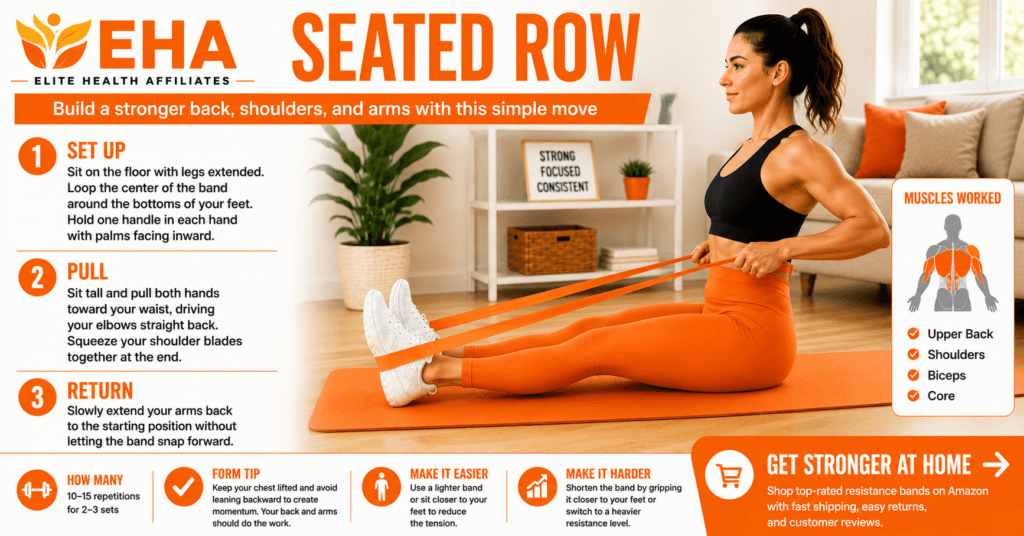
Resistance Band Workout 1: Seated Row
The seated row is one of the best resistance band exercises for strengthening the upper back, shoulders, and arms. It is also beginner-friendly because you perform the movement from a stable seated position and can easily adjust the resistance by changing how tightly you hold the band.
Sit on the floor with your legs extended in front of you and your knees slightly bent. Loop the center of the resistance band securely around the bottoms of both feet. Hold one end in each hand with your palms facing inward, sit upright, and keep your shoulders relaxed rather than raised toward your ears.
Pull both hands toward your waist while driving your elbows straight behind you. Squeeze your shoulder blades together at the end of the movement, then slowly extend your arms back to the starting position without allowing the band to snap forward.
How many: Complete 10 to 15 repetitions for 2 to 3 sets.
Form tip: Keep your chest lifted and avoid leaning backward to create momentum. Your back and arms should perform the work while your upper body remains steady.
Make it easier: Use a lighter band or sit closer to your feet to reduce the tension.
Make it harder: Shorten the band by gripping it closer to your feet or switch to a heavier resistance level.
Resistance Band Workout 2: Squat With Resistance Band
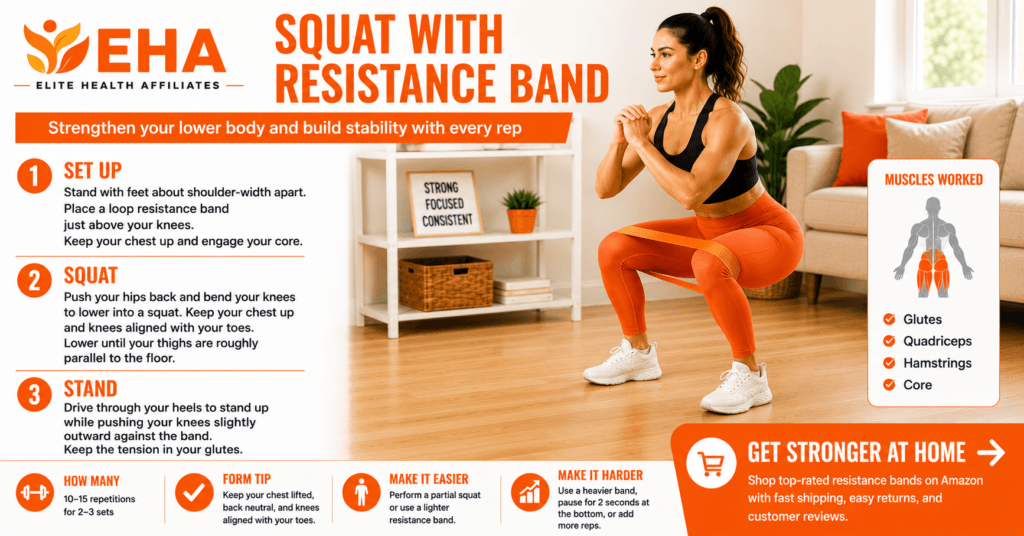
The resistance band squat strengthens the glutes, quadriceps, hamstrings, and core while encouraging proper knee alignment throughout the movement. It is an excellent lower-body exercise for beginners because the band provides constant tension without requiring heavy weights.
Stand with your feet about shoulder-width apart and place a loop resistance band just above your knees. Keep your chest up, engage your core, and push your hips back as you bend your knees into a squat. Lower until your thighs are roughly parallel to the floor or as far as you can comfortably go while maintaining good form.
Drive through your heels to return to a standing position while continuing to push your knees slightly outward against the resistance band. This keeps the glute muscles engaged throughout the exercise and helps prevent your knees from collapsing inward.
How many: Complete 10 to 15 repetitions for 2 to 3 sets.
Form tip: Keep your chest lifted, your back neutral, and your knees aligned with your toes throughout the movement.
Make it easier: Perform a partial squat or use a lighter resistance band.
Make it harder: Use a heavier loop band, pause for two seconds at the bottom of each squat, or perform additional repetitions.
Resistance Band Workout 3: Standing Chest Press
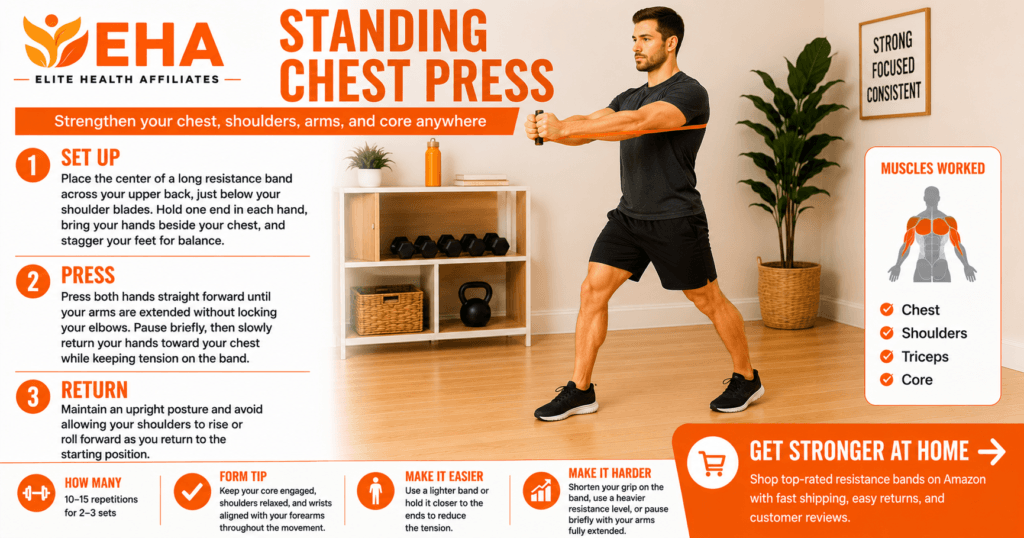
The standing chest press strengthens the chest, shoulders, triceps, and core without requiring a bench, door anchor, or mounted attachment. The resistance band wraps around your upper back, allowing your body to hold it securely while you press forward.
Place the center of a long resistance band across your upper back, just below your shoulder blades. Hold one end in each hand, bring your hands beside your chest, and stagger your feet for balance. Keep the band positioned under your arms rather than across your neck.
Press both hands straight forward until your arms are extended without locking your elbows. Pause briefly, then slowly return your hands toward your chest while keeping tension on the band. Maintain an upright posture and avoid allowing your shoulders to rise or roll forward.
How many: Complete 10 to 15 repetitions for 2 to 3 sets.
Form tip: Keep your core engaged, shoulders relaxed, and wrists aligned with your forearms throughout the movement.
Make it easier: Use a lighter band or hold it closer to the ends to reduce the tension.
Make it harder: Shorten your grip on the band, use a heavier resistance level, or pause briefly with your arms fully extended.
How Often Should You Do Resistance Band Workouts?
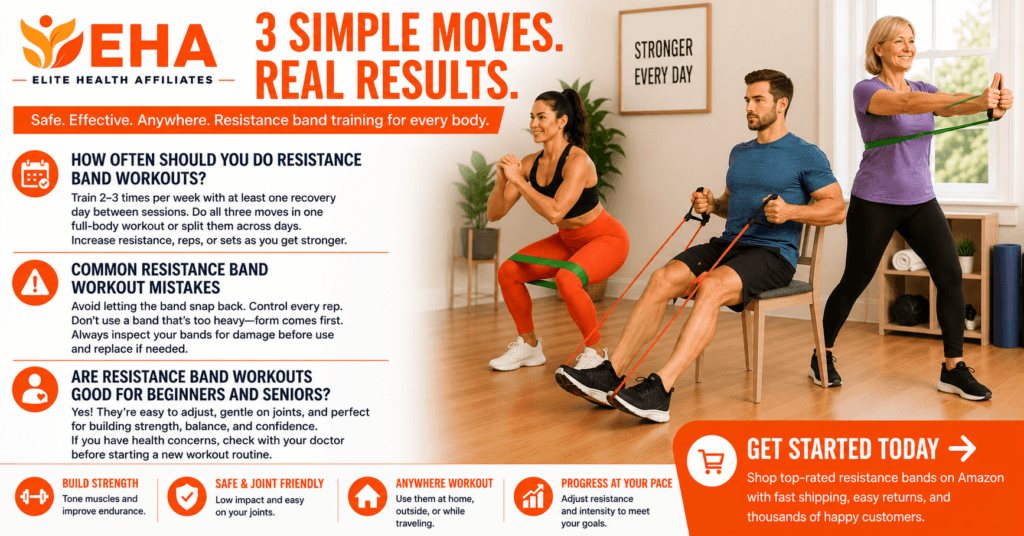
Most beginners can perform these resistance band workouts two or three times per week, with at least one recovery day between sessions that target the same muscles. This gives your body time to recover while still providing enough consistency to build strength and improve endurance.
You can complete all three exercises in one short full-body routine or divide them across different days. For example, the seated row and standing chest press can be paired for an upper-body workout, while the resistance band squat can be included in a lower-body routine.
As the exercises become easier, increase the resistance, add a few repetitions, or complete another set. Progress should come gradually. Using a heavier band before you can control the movement often leads to poor form rather than better results.
If you are looking for an easy way to track your resistance band workouts and overall activity, our Garmin Venu 4 Review looks at a fitness smartwatch that monitors workouts, heart rate, sleep, recovery, and daily movement.
Common Resistance Band Workout Mistakes
One of the most common mistakes is allowing the band to snap back into the starting position. The return portion of each exercise is just as important as the press, pull, or squat. Moving slowly in both directions keeps the muscles under tension and gives you more benefit from every repetition.
Another mistake is choosing a band that is too heavy. Resistance should make the last few repetitions challenging, but it should not force you to shorten the movement, twist your body, or rely on momentum. A lighter band used with proper form is more effective than a heavy band you cannot control.
Always inspect resistance bands before exercising. Replace any band that has cracks, tears, thinning areas, or damaged handles. Keep bands away from sharp surfaces, and make sure they are positioned securely around your body or feet before applying tension.
Are Resistance Band Workouts Good for Beginners and Seniors?
Resistance bands are a practical option for beginners because the resistance level is easy to adjust and the exercises do not require complicated equipment. Starting with a light band allows you to learn each movement before increasing the challenge.
They can also be useful for many seniors who want to improve strength, balance, mobility, and confidence at home. The seated row can be performed from a stable position, while squats can be modified by reducing the depth or using a sturdy chair for support.
Anyone with joint pain, a recent injury, balance concerns, or a medical condition should speak with a qualified healthcare professional before beginning a new workout routine. Exercises should feel challenging, but they should not cause sharp pain, dizziness, or unusual discomfort.
Pros and Cons of Resistance Band Workouts
Like any type of exercise equipment, resistance bands have strengths and limitations. The good news is that for most people looking to improve their health, build strength, or stay active at home, the advantages far outweigh the drawbacks.
Pros
- Affordable compared to most home gym equipment
- Lightweight and easy to store
- Suitable for beginners, seniors, and experienced exercisers
- Provides a full-body workout with minimal equipment
- Available in multiple resistance levels for steady progression
- Low-impact option that is easier on the joints than many high-impact workouts
- Portable enough for travel, outdoor workouts, or small living spaces
Cons
- Resistance is limited compared to heavy free weights
- Bands eventually wear out and need replacement
- Incorrect form can reduce effectiveness
- Choosing the wrong resistance level may make exercises too easy or too difficult
- Some advanced strength athletes may eventually outgrow resistance bands alone
If you are looking to move beyond resistance bands into heavier strength training, our Ultra Fuego Power Rack Review looks at a compact home-gym setup for barbell, cable, pull-up, and landmine exercises.
Looking for a complete resistance band system instead of a general workout guide? Read our Power Systems Resistance Bands Review to see how these professional-quality bands performed during testing, who they’re best for, and whether they’re worth buying for home workouts, strength training, and rehabilitation exercises.
Frequently Asked Questions About Resistance Band Workouts
Do resistance band workouts actually build muscle?
Yes. Resistance bands create progressive tension that challenges your muscles much like traditional weights. As long as you continue increasing the resistance or difficulty over time, resistance band workouts can help build strength and muscle.
Are resistance bands better than dumbbells?
Neither is better for everyone. Resistance bands are more portable, affordable, and versatile for home workouts, while dumbbells allow for heavier resistance and may be a better choice for advanced strength training. Many people benefit from using both.
How long does a resistance band workout take?
Most full-body resistance band workouts can be completed in 20 to 30 minutes. Even a short routine performed consistently several times each week can produce noticeable improvements in strength and fitness.
Can you use resistance bands every day?
You can perform light mobility or stretching exercises daily, but muscles generally benefit from a recovery day after strength training. Alternating muscle groups or taking a day off between full-body workouts usually produces better long-term results.
EHA Verdict

Resistance bands remain one of our favorite pieces of home exercise equipment because they make strength training accessible to almost everyone. They are affordable, easy to use, and versatile enough to provide effective workouts whether your goal is building muscle, improving mobility, increasing endurance, or simply becoming more active.
After testing these exercises under the supervision of a registered nurse, we found that a simple routine built around the seated row, resistance band squat, and standing chest press delivers an effective full-body workout without requiring bulky equipment or an expensive gym membership. For beginners, seniors, and anyone looking for a practical way to exercise at home, resistance bands are an excellent investment.
Where to Buy Resistance Bands
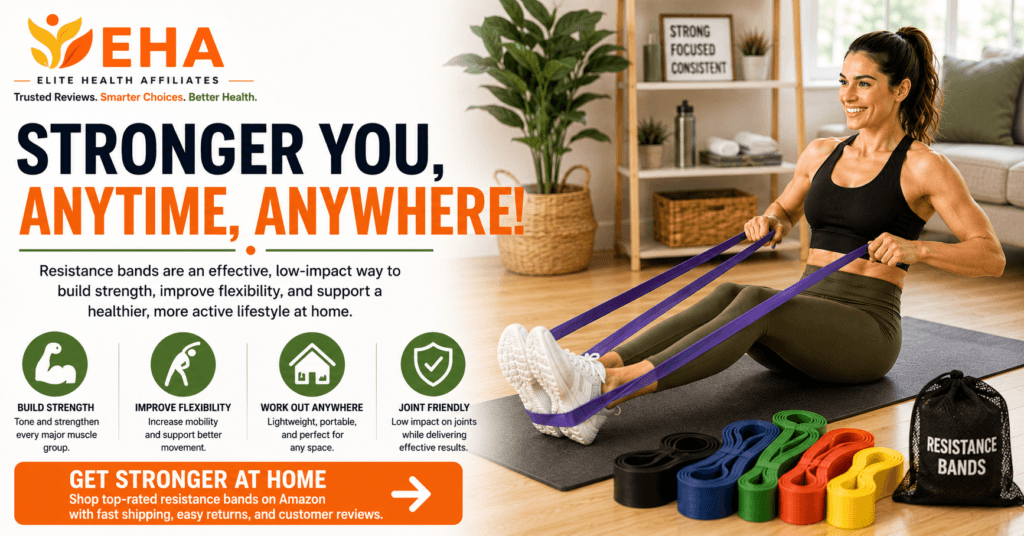
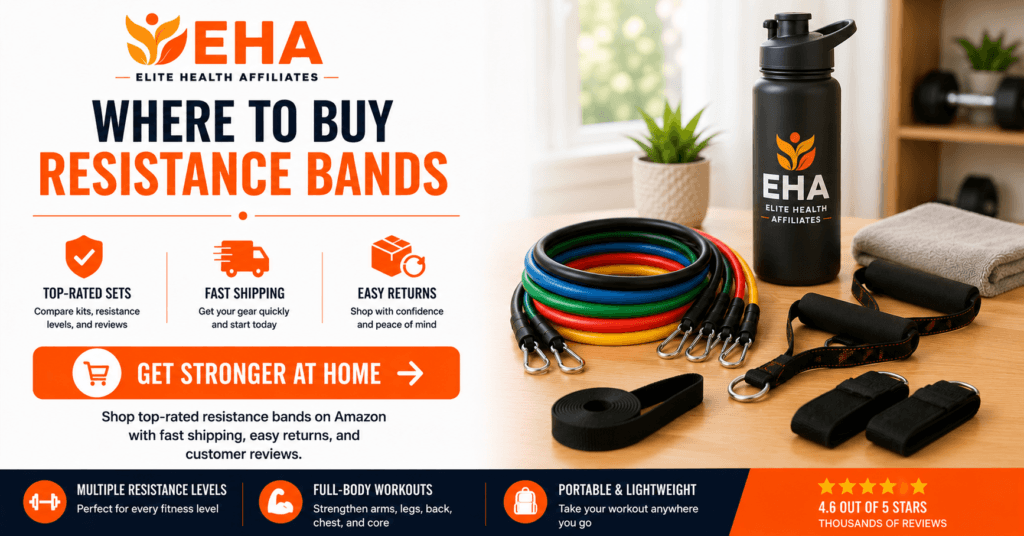
Resistance bands are widely available, but Amazon is the easiest place to compare complete sets, resistance levels, handle styles, and customer reviews in one place. Look for a set that includes several resistance levels so you can use lighter bands for smaller muscle groups and heavier bands for lower-body exercises.
A complete kit may also include handles, ankle straps, a storage bag, and optional accessories. Before buying, check the band lengths, listed resistance range, materials, and recent customer feedback. The best choice is not necessarily the heaviest set, but the one that gives you enough variety to progress safely.
Ready to Build Strength at Home?
Compare top-rated sets, resistance levels, accessories, customer reviews, and shipping options on Amazon
Explore More Fitness Equipment Reviews and Guides
Looking for more ways to support your health and fitness goals? Browse our Fitness Equipment reviews and guides for trusted product reviews, in-depth buying advice, workout equipment comparisons, and practical recommendations for strength training, cardio, recovery, mobility, and home exercise. Whether you’re just getting started or upgrading your routine, we’ll help you choose equipment that’s worth your investment.