
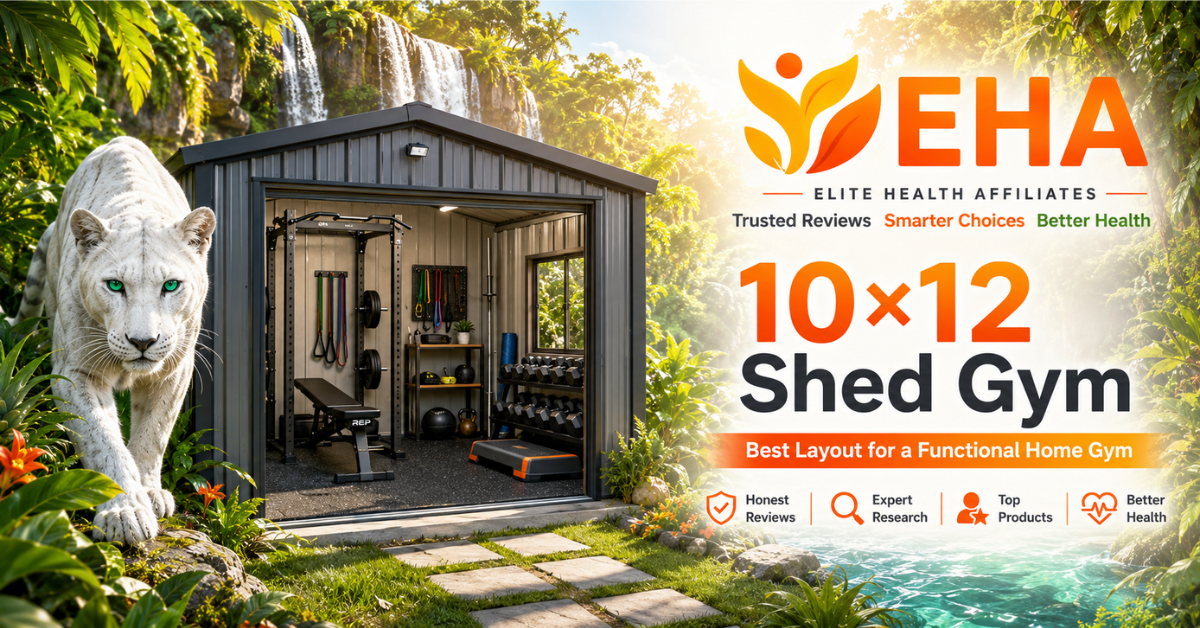
Can a 10×12 shed really make a good home gym? Yes. With 120 square feet to work with, a well-planned shed gym can comfortably support strength training, cardio, mobility work, and equipment storage without taking over a room inside your house.
The key is layout. A 10×12 space is large enough for useful equipment such as a power rack, adjustable bench, dumbbells, resistance bands, and a compact cardio option, but it is small enough that poor placement can make the room feel crowded fast. The best setup keeps the center of the gym open, uses the walls for storage, and gives each piece of equipment enough clearance to be used safely.
In this guide, we’ll show how to turn a 10×12 shed into a functional home gym, including the layout, flooring, ventilation, lighting, storage, and equipment choices that make the biggest difference. We’ll also use a 10×12 metal shed as the practical example so you can see what actually fits and where the compromises begin.
This post contains affiliate links. If you purchase through them, we may earn a small commission at no extra cost to you.
Table of Contents
Is a 10×12 Shed Big Enough for a Home Gym?
Yes, a 10×12 shed is big enough for a very capable home gym, but it works best when you treat the 120 square feet as a planned training space rather than trying to squeeze in every piece of equipment you would find at a commercial gym. The goal is to choose equipment that earns its footprint and arrange it so you still have room to move, lift, and transition safely between exercises.
A strength-focused setup can include a power rack, adjustable bench, dumbbells, and resistance bands while still leaving room for bodyweight work or compact cardio equipment. If cardio is more important, you can dedicate more open floor space to a step platform, bike, rower, or mobility work and keep the strength equipment simpler. The available space gives you options, but every large piece you add affects what can comfortably fit around it.
Ceiling height and door placement matter almost as much as floor dimensions. A rack needs enough vertical clearance, a barbell needs room on both sides, and equipment placed too close to the entrance can make the entire gym feel cramped. Planning those details before buying equipment is much easier than rearranging a packed shed later.
Our 10×12 Shed Gym Layout
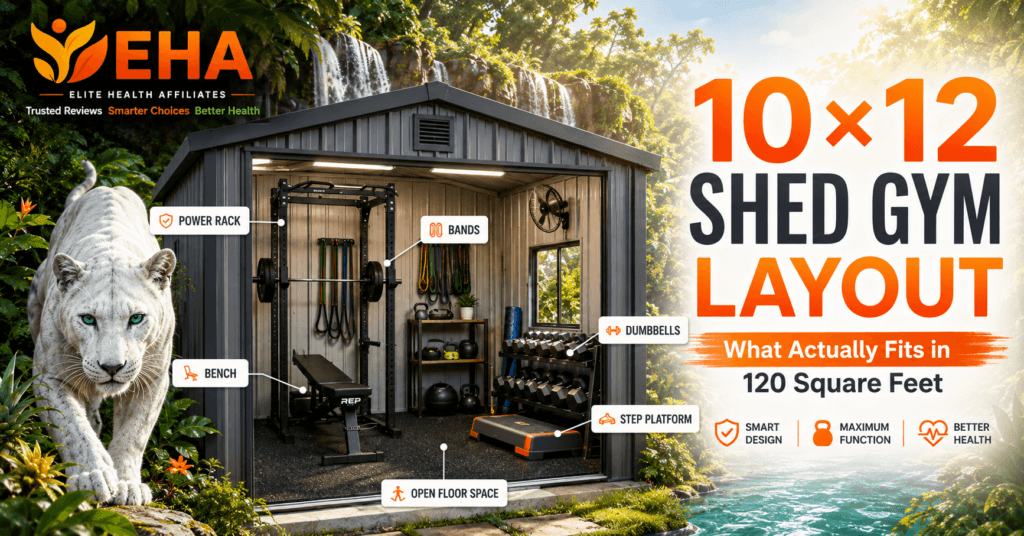
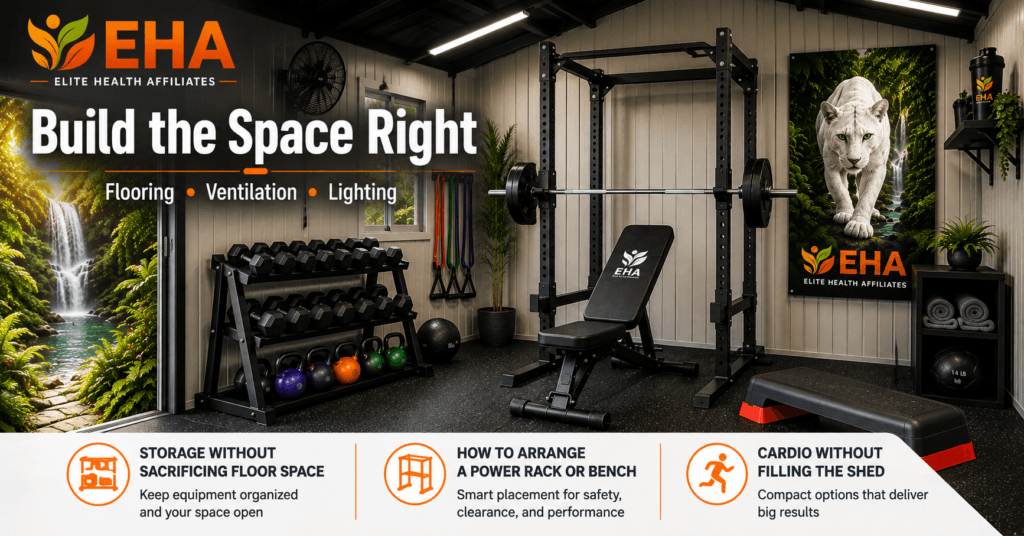
For a 10×12 shed, we would build the layout around one primary strength station and keep the center of the room as open as possible. A power rack or similar large piece belongs against one of the longer walls where there is enough clearance to use a bench and move around the rack without blocking the entrance.
If a rack is part of your plans, our Ultra Fuego Power Rack Review looks at the type of compact strength setup that can work well in a dedicated home gym.
Dumbbells and smaller weights can be stored along another wall on a narrow rack, while resistance bands, jump ropes, and similar accessories are better hung vertically. That keeps equipment off the floor and preserves the open space you need for warmups, stretching, bodyweight exercises, and movement between stations.
We would reserve another section of the room for compact cardio and flexible training. A step platform is ideal here because it can be moved when you need more floor space and used for cardio, HIIT, and strength-focused movements without permanently occupying a large section of the gym.
Our Reebok Step Review covers one adjustable option that fits especially well into this type of smaller workout space.
The most important part of the layout is resisting the temptation to fill every empty spot. A 10×12 shed feels surprisingly roomy when the center remains open, but it can become crowded very quickly when benches, machines, and storage begin creeping into the walking and training areas.
What Fits in a 10×12 Home Gym?
A 10×12 home gym can hold more equipment than the size might suggest, especially when you prioritize versatile pieces. A compact power rack and adjustable bench can become the strength-training centerpiece, while dumbbells provide additional exercise options without requiring several separate machines. Wall-mounted or narrow storage keeps those weights organized without consuming valuable training space.
Resistance bands are particularly useful in a shed gym because they add a wide range of strength and mobility exercises while taking up almost no floor space. Our Power Systems Resistance Bands Review looks at one option for adding resistance training to a compact setup, while our Resistance Bands Workout Guide shows how bands can be worked into a broader home fitness routine.
For cardio, smaller equipment usually makes more sense than trying to force a full-size treadmill into the room. An adjustable step, compact bike, or foldable rower can provide plenty of conditioning while leaving the gym flexible enough for other workouts. The Reebok Step is especially useful in this type of layout because it can be moved aside when you need open floor space instead of permanently claiming part of the room.
The best 10×12 home gym is not necessarily the one with the most equipment. It is the one where you can walk in, use every major piece comfortably, and still have enough open space to train without constantly moving equipment out of your way.
Best Flooring for a Shed Gym
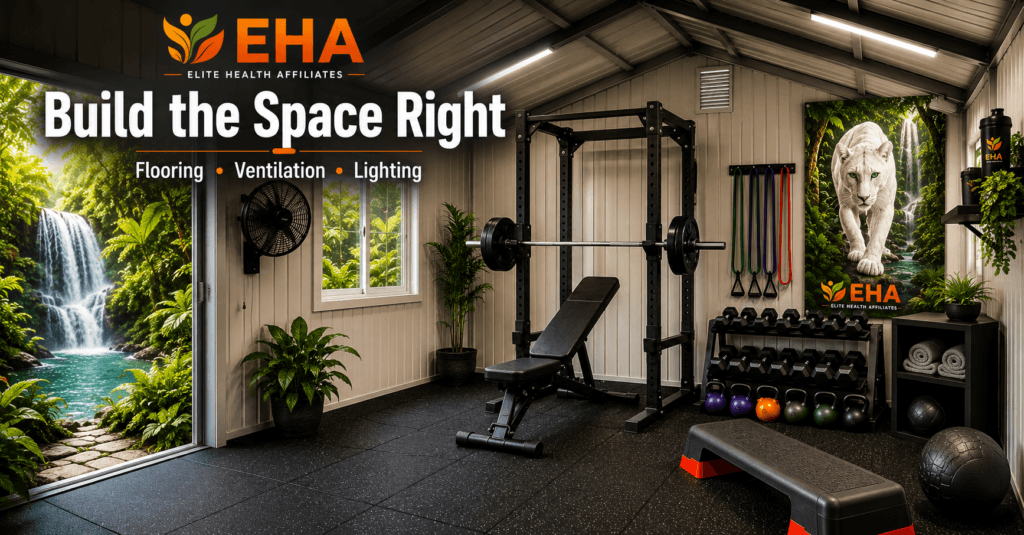
Flooring is one of the first things we would address before moving heavy equipment into a 10×12 shed gym. A bare metal or thin factory floor may be fine for storage, but it is not ideal for repeated workouts, dropped dumbbells, bench work, or equipment that puts concentrated pressure on a small area.
Rubber flooring is usually the best fit because it adds grip, protects both the shed floor and your equipment, and gives the room a more finished gym feel. Heavy rubber mats or stall mats work especially well around a power rack and dumbbell area, while interlocking rubber tiles can be easier to install if you want full-wall-to-wall coverage. Foam tiles are softer and lighter, but we would reserve those for stretching or lighter exercise areas rather than underneath heavy strength equipment.
Moisture also matters in a backyard shed. Before laying flooring, make sure the base is level and dry and that water cannot collect underneath the structure. In humid climates, leaving moisture trapped beneath mats can eventually create odor or mildew problems, so the flooring choice should work together with good ventilation rather than simply covering the floor and forgetting about it.
For a 10×12 layout, we would prioritize the heaviest-duty flooring underneath the rack, bench, and dumbbells, then use the remaining area for a cleaner open training surface. That gives the high-impact areas extra protection without making the entire project more expensive than it needs to be.
If you are looking for a simple starting point, Amazon has a wide selection of rubber gym flooring and heavy-duty exercise mats that work well for protecting a shed floor and giving workout equipment a more stable surface.
Ventilation and Temperature Control
A metal shed can become uncomfortable surprisingly quickly once you start exercising inside it. Heat builds faster than it would in a room inside the house, and a hard workout adds even more warmth and humidity. That makes ventilation one of the most important parts of turning a storage shed into a space you will actually want to use throughout the year.
At minimum, we would want some combination of vents, an openable window, and a fan that keeps air moving through the room. Cross-ventilation works especially well when air can enter from one side of the shed and exit from another instead of simply circulating hot air in the same enclosed space. Even a relatively small fan can make a noticeable difference when the shed already has a path for fresh air to move through.
In hotter climates, a portable or window air conditioner may be worth considering if the shed can support it safely. Insulation can also help control temperature swings, particularly if the gym will be used during both summer and winter. The more time you plan to spend training in the shed, the more important these comfort upgrades become.
Humidity deserves attention too. Sweat, outdoor moisture, and temperature changes can all contribute to condensation, which is not something you want around metal gym equipment. Good airflow, keeping the shed dry, and occasionally checking equipment for moisture are simple habits that can help prevent rust and keep the space more comfortable.
Lighting and Electrical Setup
Good lighting changes the feel of a shed gym more than most people expect. A dim storage building may technically have enough space for equipment, but it does not feel like a finished workout area until you can clearly see the floor, equipment, and movement space around you.
Natural light is useful if the shed has windows, but we would still add bright LED lighting for early mornings, evenings, or cloudy days. Overhead fixtures work well because they illuminate the room without taking up wall or floor space, and placing more than one light source helps reduce shadows around a rack or bench.
Electrical planning should happen before the gym is packed with equipment. Fans, lighting, a small air conditioner, speakers, charging devices, or a television can quickly create more demand than a single extension cord should handle. If the shed needs permanent electrical service, having it installed properly is a much better long-term solution than running temporary cords across the yard or workout area.
Inside the gym, keep cords along walls and away from the center floor space. A 10×12 shed already requires thoughtful use of every square foot, and loose cords are one more obstacle you do not need around barbells, benches, or fast-moving cardio exercises. A clean electrical setup keeps the space safer and makes the finished shed feel much more like a dedicated home gym than a converted storage building.
Storage Without Sacrificing Floor Space
Storage can make or break a 10×12 shed gym. The room may technically have 120 square feet, but once dumbbells, bands, mats, plates, and smaller accessories start spreading across the floor, the usable workout area shrinks fast. The smartest approach is to move as much storage as possible to the perimeter and keep the center of the gym open.
Wall hooks are ideal for resistance bands, jump ropes, straps, and other lightweight equipment. Narrow shelving works well for smaller accessories, while a compact dumbbell rack keeps weights organized without taking over an entire wall. If you use kettlebells or medicine balls, placing them on a low shelf or dedicated corner rack keeps them accessible without creating tripping hazards.
Vertical storage is especially valuable in a shed gym because wall space is easier to replace than floor space. Even simple additions such as hooks, pegboard, and mounted shelves can make the room feel considerably larger by getting loose equipment off the ground.
We would also avoid filling every wall with storage just because the space is available. The goal is not to turn the shed into an equipment warehouse. A good 10×12 layout should still leave room to move freely, set up a bench, stretch, and complete bodyweight exercises without rearranging the room every time you train.
If your shed does not come with wall hooks or built-in storage, Amazon has a wide selection of garage and gym wall hooks that can help keep resistance bands, jump ropes, straps, and other lightweight equipment organized and off the floor.
How to Arrange a Power Rack or Bench
A power rack is one of the largest pieces of equipment you can put in a 10×12 shed, so its position should be decided before almost anything else. In most layouts, placing the rack against one of the longer walls gives you the best balance between usable rack space and open floor area.
Clearance around the rack matters just as much as the rack itself. You need enough room to load and unload a barbell, move a bench in and out, and step safely around the equipment without hitting walls, shelving, or other gear. The rack should also be positioned so the barbell does not interfere with the shed door or block the main walking path through the room.
A bench works best when it can be moved rather than permanently occupying the center of the shed. Keep it near the rack when you are using it for presses or other strength exercises, then slide it back toward a wall when you want more room for cardio, mobility, or bodyweight training.
If a rack is part of your setup, our Ultra Fuego Power Rack Review looks at a compact home-gym option that fits naturally into this type of strength-focused layout.
The biggest mistake would be centering the entire room around equipment that rarely moves. A 10×12 shed becomes much more functional when the rack stays fixed, but the bench and smaller equipment can be repositioned depending on the workout.
Helpful Tip: Before choosing a power rack or cage, measure the shed’s interior height, width, and door opening—not just the floor space where the rack will sit. Some power cages are too large to carry through the doorway once assembled, which means you may need to build the rack inside the shed. Also leave enough clearance above the rack for pull-ups and around both sides of the barbell so you can load plates comfortably without hitting the walls.
Cardio Without Filling the Shed
You do not need a full-size treadmill to get effective cardio in a 10×12 shed gym. In fact, large cardio machines can consume so much floor space that they limit everything else you can do in the room. Compact equipment usually gives you a better balance between conditioning and overall flexibility.
An adjustable step platform is one of the easiest additions because it can support traditional cardio, HIIT, step intervals, and even strength-focused exercises without permanently occupying a large section of the gym. When the workout is finished, it can be moved against a wall or stored with other equipment to reopen the floor.
Our Reebok Step Review looks at an adjustable platform that works particularly well in this type of compact home gym because it adds cardio and training variety without demanding the footprint of a treadmill or larger machine.
A compact exercise bike or foldable rower can also work if cardio is a major priority, but we would still consider how often the machine will actually be used before giving up that much floor space. For many home gyms, a step platform combined with bodyweight intervals, jump rope, and strength circuits provides plenty of conditioning while keeping the room adaptable.
That flexibility is one of the biggest advantages of a shed gym. Instead of designing the entire space around one cardio machine, you can keep the center open and change the room to match the workout you are doing that day.
Using Resistance Bands in a Small Shed Gym
Resistance bands are one of the easiest ways to add more training options to a 10×12 shed gym without giving up valuable floor space. A full set can hang on a few wall hooks, stay out of the way when you are not using it, and still give you enough resistance for upper-body work, lower-body exercises, mobility training, and warmups.
They also pair well with the rest of a compact gym setup. You can use bands alongside a bench, rack, dumbbells, or step platform without needing another dedicated workout station. That makes them especially useful in a shed where every permanent piece of equipment has to justify the space it occupies.
Another advantage is how quickly bands can be put away. Once the workout is finished, they can go straight back onto wall hooks instead of remaining on the floor or requiring another storage rack. In a smaller gym, simple details like that help keep the space open and ready for the next workout.
If resistance training will be a regular part of your setup, choosing a good set of bands gives you a lot of exercise variety for very little space. That is exactly the kind of equipment that makes sense in a 120-square-foot home gym.
If you are looking to add resistance training without taking up much space, Amazon has a wide selection of resistance bands for home workouts that can be stored easily on wall hooks or shelves inside a shed gym.
What We Would Avoid in a 10×12 Shed Gym
The easiest way to ruin a good 10×12 shed gym is to treat every empty section of floor as a place for another piece of equipment. The space works because it is compact and flexible, so anything that permanently removes a large portion of the workout area deserves some serious thought before it comes through the door.
Oversized multi-station machines would be near the top of our avoid list. They may offer plenty of exercise options, but many are simply too large to make sense in a 10×12 room. The same applies to multiple fixed benches, large cardio machines that rarely get used, and bulky storage systems that extend too far into the training area.
We would also avoid buying equipment before measuring the actual interior dimensions of the shed. Exterior measurements do not always tell you how much usable room you will have once walls, framing, doors, shelving, and other features are taken into account. Measure first, especially for a power cage, treadmill, or anything else that requires substantial clearance.
Finally, do not overlook the environment itself. Filling the shed with expensive equipment before dealing with flooring, ventilation, moisture, and lighting can create problems that are much harder to correct later. The shed needs to work as a comfortable training space first. The equipment comes second.
Using a Patiowell 10×12 Shed as the Starting Point
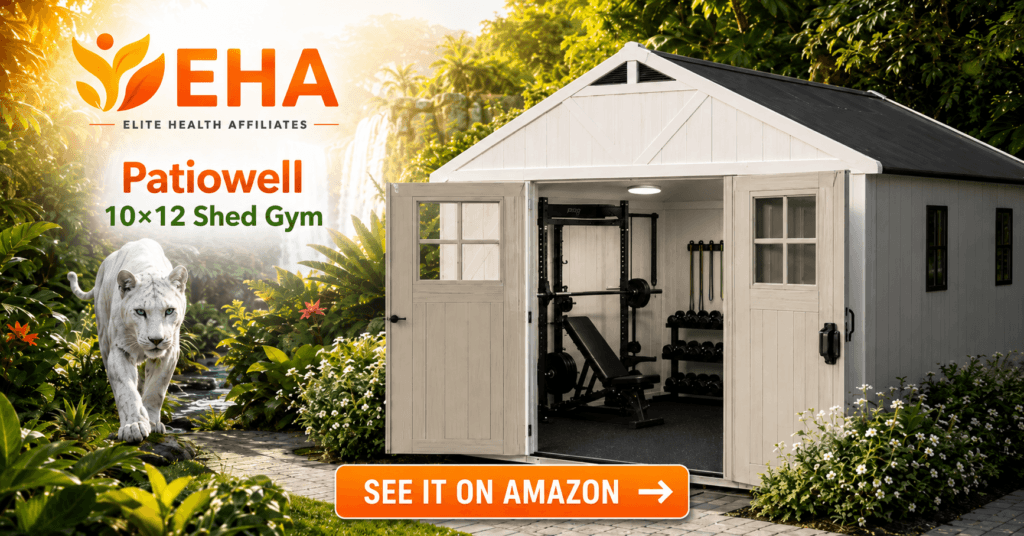
The Patiowell 10×12 metal shed is the structure that originally inspired this home gym idea, and its footprint provides a useful example of what can be done with roughly 120 square feet. A shed in this size range gives you enough room to create separate strength, cardio, and storage areas while still being compact enough to fit into many backyard spaces.
We would not choose a shed based on dimensions alone, though. Before buying any 10×12 model, look closely at the actual interior measurements, door width, roof height, ventilation options, floor or foundation requirements, and how the structure will be anchored. Those details determine whether your planned equipment will actually fit and whether the finished space will be comfortable to use.
Door clearance is particularly important if you plan to install larger equipment. A power rack or cage may need to be assembled inside the shed, while long barbells, benches, and cardio equipment still have to make it through the entrance. Planning those details before the shed is full of equipment can save a lot of frustration later.
The Patiowell shed can work as the shell for this type of setup, but the bigger lesson applies to any shed you consider: choose the building around the gym you want to create, not the other way around. Start with the equipment dimensions, required clearances, and environmental needs, then make sure the shed gives you enough room to make the entire layout work.
We highly recommend the Patiowell 10×12 Metal Shed on Amazon for anyone looking to create a dedicated backyard home gym with enough room for strength equipment, cardio, storage, and open workout space.
Cost of Building a 10×12 Shed Gym
The total cost of a 10×12 shed gym depends heavily on how much of the setup you already own and how finished you want the space to feel. The shed itself is usually the largest starting expense, but flooring, lighting, ventilation, storage, and workout equipment can add up quickly once you move beyond a basic setup.
We would think about the budget in stages rather than trying to buy everything at once. Start with the structure, proper flooring, ventilation, and lighting first. Those are the pieces that make the shed safe and comfortable to use. From there, add the equipment that matters most to your workouts, whether that is a rack and bench, dumbbells, resistance bands, or compact cardio equipment.
This approach also makes it easier to avoid wasting money on equipment that does not fit the space well. A 10×12 gym can become very capable over time, but it does not need to be fully loaded on day one. Building the room around your priorities usually leads to a better layout and a more useful gym.
10×12 Shed Gym Pros and Cons
Pros
- Creates a dedicated workout space outside the house
- 120 square feet is enough for a compact strength and cardio setup
- Keeps workout equipment organized in one place
- Works well with versatile, space-saving equipment
- Can be upgraded gradually as your needs change
- Gives you more privacy than working out in a shared room or garage
Cons
- Temperature control requires planning
- Moisture and condensation can become an issue
- Large equipment needs to be measured carefully before installation
- Electrical work may add extra cost
- Floor space fills up quickly if you add too many fixed machines
- Some power racks or cages may need to be assembled inside the shed
Frequently Asked Questions About 10×12 Shed Gyms
Is a 10×12 shed big enough for a home gym?
Yes. A 10×12 shed gives you about 120 square feet, which is enough for a well-planned home gym with a power rack, bench, dumbbells, resistance bands, compact cardio equipment, and open workout space. The key is choosing versatile equipment and avoiding oversized machines that dominate the room.
Can a power rack fit in a 10×12 shed?
Yes, but you need to measure carefully. Check the rack height, width, barbell clearance, and the shed door opening before buying. Some racks are too large to carry through the doorway once assembled, so you may need to build the rack inside the shed.
What flooring is best for a shed gym?
Rubber flooring is usually the best choice because it improves traction, protects the shed floor, reduces noise, and handles heavy equipment better than basic foam tiles. Heavy rubber mats are especially useful underneath a rack, bench, and dumbbell area.
How do you cool a metal shed gym?
Good ventilation should come first. Vents, windows, and fans help move hot air out and bring fresh air in. If you are looking for more temperature control, a portable or window air conditioner may also make sense depending on the shed design and electrical setup.
Can you leave gym equipment in a shed year-round?
Yes, but the shed needs to stay dry and reasonably ventilated. Moisture and condensation can damage metal equipment over time, so check for leaks, keep air moving, and inspect weights, racks, and other steel equipment periodically for signs of rust.
How much equipment fits in a 10×12 gym?
More than most people expect, but only if the layout stays organized. A compact power rack, movable bench, dumbbell rack, resistance bands, step platform, and some open training space can all fit comfortably. The mistake is trying to add several large machines that permanently occupy the center of the room.
How to Make a 10×12 Shed Gym Feel Bigger
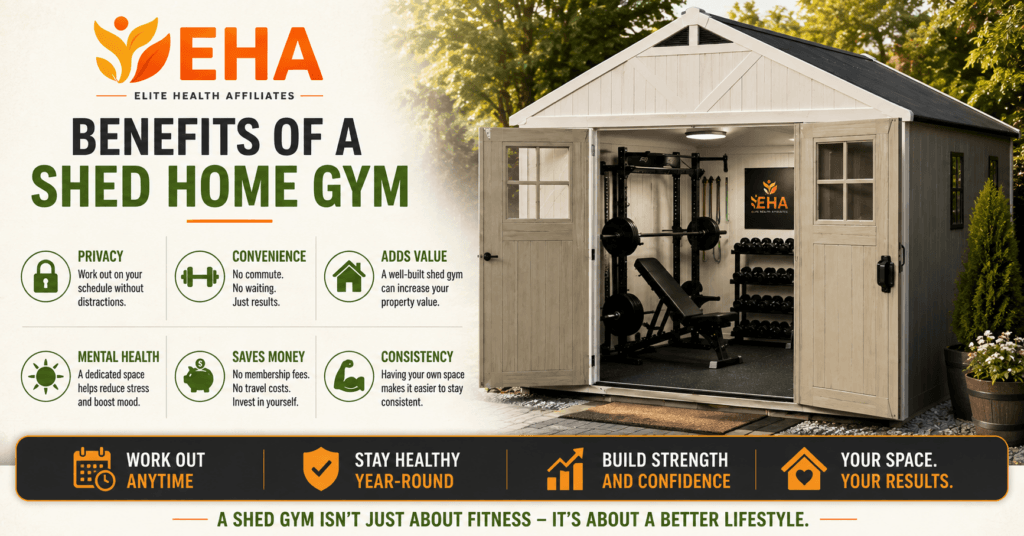
A 10×12 shed gives you enough room for a very capable home gym, but the space will feel much larger if you keep the layout visually open. The easiest way to do that is to avoid placing tall equipment on every wall and to keep the center of the room as clear as possible.
Mirrors can help by reflecting light and making the room feel less enclosed, while bright wall colors and good LED lighting can keep a metal shed from feeling dark or cramped. Open shelving is also a better choice than bulky cabinets in most shed gyms because it keeps equipment visible without making the walls feel closed in.
Equipment placement matters just as much. Keep larger pieces such as the power rack against the perimeter, store smaller accessories vertically, and use movable equipment whenever possible. A bench, step platform, or set of resistance bands can be repositioned as needed, giving you more flexibility than filling the room with fixed machines.
The goal is not to make 120 square feet look like a commercial gym. It is to make the space feel organized, comfortable, and easy to move through. When the layout stays open and uncluttered, a 10×12 shed can feel surprisingly spacious during an actual workout.
EHA Verdict: Does a 10×12 Shed Make a Good Home Gym?

Yes. A 10×12 shed makes an excellent home gym when the layout is planned around the equipment you actually use instead of trying to recreate a commercial gym in 120 square feet.
The biggest advantage is having a dedicated workout space without giving up a bedroom, basement, or garage. With smart placement, a power rack, bench, dumbbells, resistance bands, and compact cardio equipment can all fit while still leaving enough open floor space to move safely and comfortably.
The shed itself is only part of the equation, though. Flooring, ventilation, lighting, storage, and equipment clearance are what determine whether the space feels like a real gym or simply a storage building with workout gear inside. Get those pieces right first, and a 10×12 layout becomes far more practical than its size might suggest.
For most home users, we would rather have a well-planned 10×12 shed gym with versatile equipment and open space than a larger room packed with machines that rarely get used.
Explore More Fitness Equipment Reviews and Guides
A good shed gym starts with the space, but the equipment you choose determines how useful that space becomes. We have reviewed additional power racks, resistance bands, workout platforms, benches, and home fitness equipment to help you compare options and build a setup that fits both your training style and available room.