
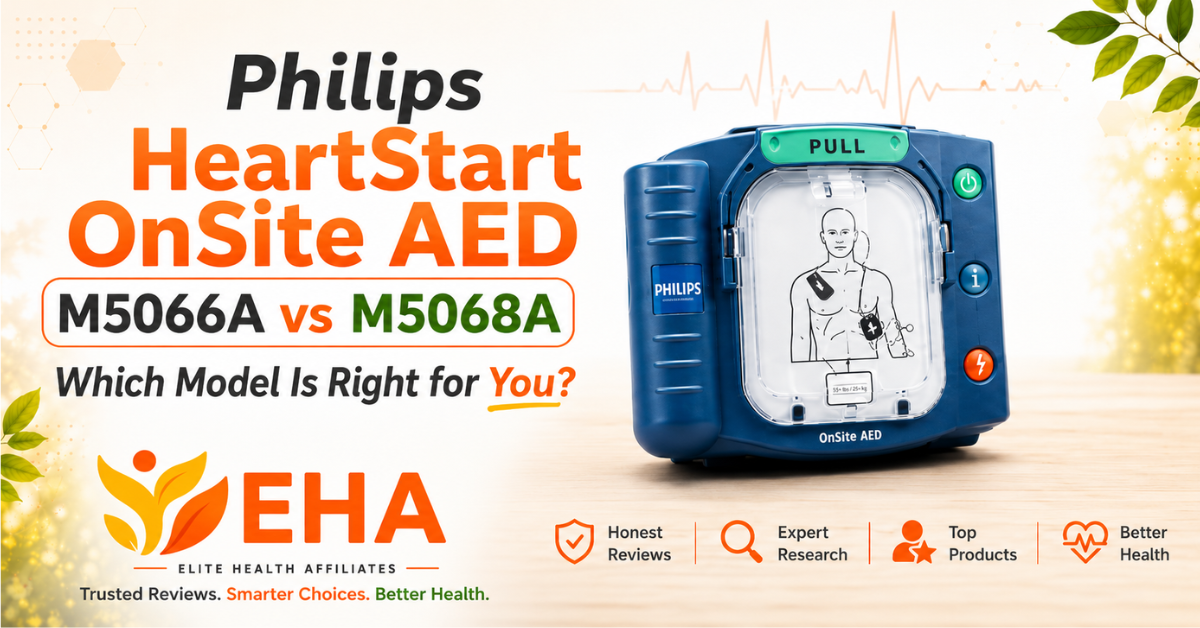
Philips HeartStart OnSite AEDs are built to help everyday people respond during sudden cardiac arrest, even without a medical background. Clear voice prompts, simple visual guidance, and automatic rhythm analysis make the device easier to follow in a high-stress emergency, whether it is kept at home, in an office, at a school, inside a gym, or in another public setting.
The M5066A and M5068A are two of the most commonly purchased Philips HeartStart OnSite options, and at first glance they can appear nearly identical. Both use the same core AED technology, but differences in how they are packaged, what may be included, and the type of buyer each one is best suited for can affect the final decision.
Quick answer: The better choice depends less on the AED itself and more on the package, accessories, and setting where it will be used. One option may make more sense for straightforward home preparedness, while the other may offer better value for a workplace or organization that needs a more complete setup.
In this comparison, we break down the practical differences between the Philips HeartStart OnSite M5066A and M5068A, explain which details actually matter, and help you decide which option fits your needs without getting buried in technical language. Our evaluation is guided by RN-supervised review, with an emphasis on usability, preparedness, and real-world value.
This post contains affiliate links. If you purchase through them, we may earn a small commission at no extra cost to you.
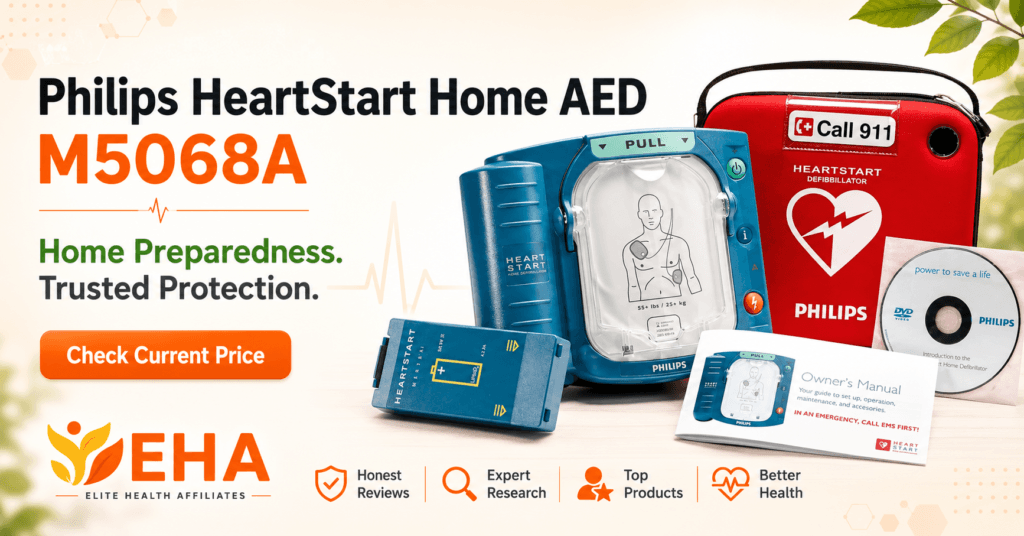
Table of Contents
What the Philips HeartStart AED Is
The Philips HeartStart OnSite M5066A and HeartStart Home M5068A are closely related automated external defibrillators designed to guide ordinary people through a suspected sudden cardiac arrest emergency. Both provide step-by-step voice instructions, help with pad placement and CPR, analyze the person’s heart rhythm, and advise a shock only when the device determines one is appropriate.
Unlike the manual defibrillators used by trained medical professionals, these Philips models are intended to reduce the number of decisions the responder must make. The device guides the process from startup through rhythm analysis, CPR, and potential shock delivery, which can make it more approachable for someone with little or no previous AED experience.
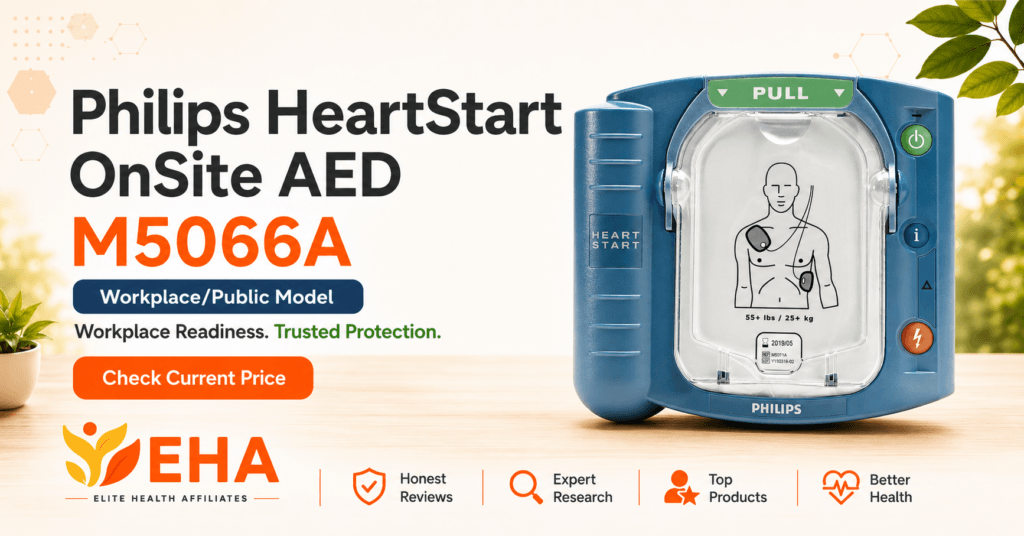
The M5066A is marketed as the HeartStart OnSite AED for workplaces, schools, businesses, community facilities, and other public-access environments. The M5068A is marketed as the HeartStart Home AED and was specifically positioned for household emergency preparedness.
What the Philips HeartStart AED Does
Once activated, the AED provides audible and visual instructions that guide the responder through exposing the chest, attaching the pads, and allowing the device to analyze the heart rhythm. If the AED identifies a shockable rhythm, it instructs the user to stand clear and press the shock button. If a shock is not appropriate, the device will not allow one to be delivered.
Both models also adjust the timing of their voice instructions according to the responder’s actions. This helps keep the process moving without forcing the user to work through menus or interpret complex medical information. Their purpose is not to replace CPR, calling 911, or professional emergency care, but to help bridge the critical period before emergency responders arrive.
How We Evaluated the M5066A and M5068A
We evaluated the two models through simulated home and workplace scenarios under RN supervision. We did not administer shocks. Instead, we focused on the parts of AED ownership and operation that an everyday buyer is most likely to experience, including setup, readiness checks, voice guidance, training-pad placement, portability, storage, battery installation, and routine maintenance.
We also considered how quickly someone without previous AED experience could understand the instructions and move through the response sequence. Because the M5066A and M5068A use very similar core technology, the evaluation focused heavily on their intended settings, package contents, purchasing requirements, and overall value rather than trying to create performance differences that are not actually there.
What We Discovered
The biggest finding is that the M5066A and M5068A are far more alike than different. Both are part of the Philips HeartStart HS1 family, use the same replacement battery, support adult SMART Pads, and can be used with optional infant/child SMART Pads when treating younger patients. Both also perform automatic self-tests to help confirm readiness.
That means the decision should not be based on claims that one model is lighter, has a longer-lasting battery, offers stronger self-testing, or includes pediatric capability that the other does not. Philips’ official information does not support those distinctions. The more meaningful difference is how each model is marketed, packaged, and purchased.
The M5068A HeartStart Home AED is specifically intended for household use and is available without a prescription. Its packages are built around home preparedness and may include household-oriented materials or training accessories.
The M5066A HeartStart OnSite AED is generally positioned for offices, schools, gyms, churches, businesses, and other public-access environments. It is commonly sold in packages that may include carrying cases, spare adult pads, wall mounts, cabinets, signage, or response kits.
In practical use, both models offer the same main advantage: straightforward Philips guidance designed to help a non-medical responder act with greater confidence. The best choice therefore depends less on differences in lifesaving performance and more on where the AED will be kept, what comes with the package, and whether it is being purchased for a home or an organization.
Philips HeartStart OnSite AED: M5066A vs M5068A Comparison
Who These Models Are Best For
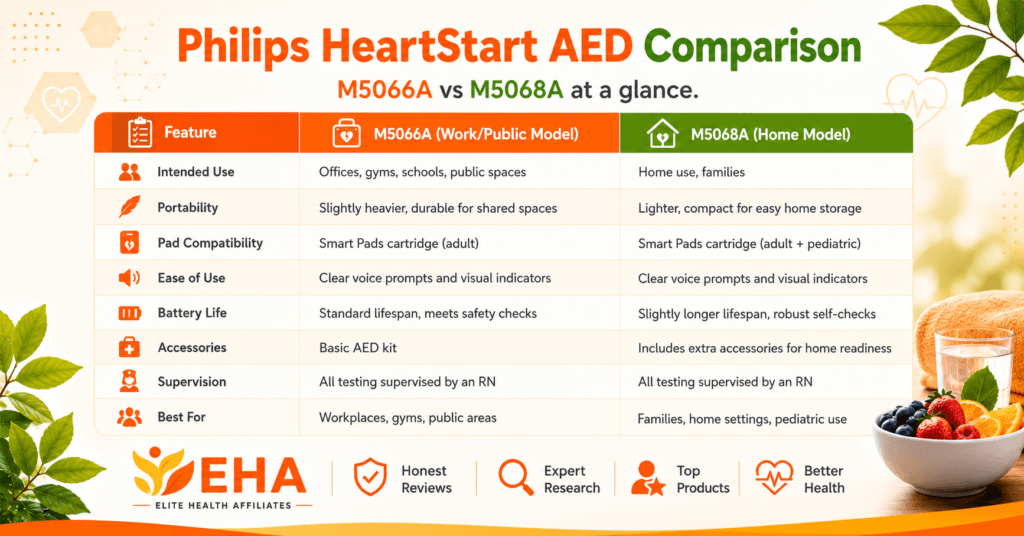
Choosing between the Philips HeartStart Home M5068A and the Philips HeartStart OnSite M5066A comes down mostly to where the AED will be kept and what type of package makes the most sense. The devices themselves are very similar, so the setting, included accessories, and intended use should guide the decision more than the model number alone.
Philips HeartStart Home M5068A
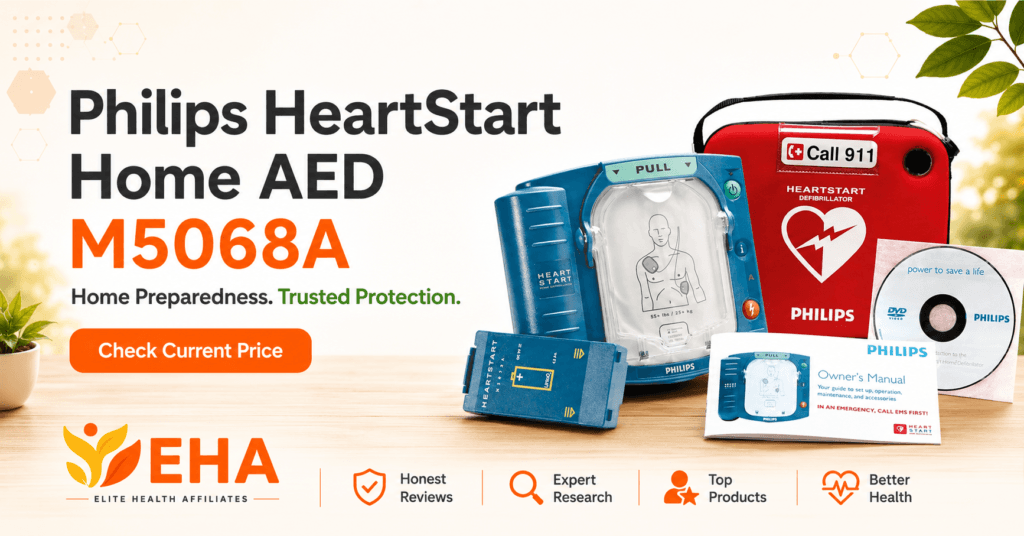
The M5068A is the better fit for households that want a straightforward AED for home emergency preparedness. It is designed to be stored in a home setting and is a practical option for families who want a device that can guide a non-medical responder through a sudden cardiac arrest emergency.
It may be especially appealing in homes where someone has known cardiac risk factors or where emergency response times could be longer. The M5068A can also be used with optional infant and child SMART Pads, but those pads are not unique to this model and may need to be purchased separately.
Philips HeartStart OnSite M5066A
The M5066A is generally the stronger fit for offices, schools, churches, gyms, community centers, and other shared locations. It is commonly sold in workplace-oriented packages that may include a carrying case, wall cabinet, signage, rescue kit, or additional supplies.
That can make it easier for an organization to build a complete emergency-readiness setup instead of purchasing the AED and accessories one item at a time. The M5066A also makes sense in environments where several employees or volunteers may need access to the device.
Both models provide the same core Philips guidance and are designed to help everyday responders act with greater confidence. The M5068A is usually the more natural choice for home preparedness, while the M5066A is better suited to workplaces and public-access locations where a complete package and visible placement may matter more.
Pros and Cons
The Philips HeartStart M5066A and M5068A use the same core AED technology, so the main differences are not in lifesaving performance. The better choice usually comes down to where the device will be stored, how it will be packaged, and which accessories are included.
Philips HeartStart Home AED M5068A
Pros
- Designed for home preparedness: The M5068A is marketed specifically for household use and is a natural fit for families who want an AED stored at home.
- Beginner-friendly operation: Clear voice prompts and visual guidance help walk a non-medical responder through the rescue process.
- Compact and easy to store: Its design works well for closets, cabinets, kitchens, bedrooms, or other accessible household locations.
- Compatible with optional infant/child pads: Families can add Philips infant/child SMART Pads when pediatric capability is needed.
- Home-focused package options: Depending on the seller, packages may include a carrying case, instructional materials, or other accessories intended for household preparedness.
Cons
- Fewer public-access accessories may be included: Home packages may not include wall cabinets, signage, rescue kits, or other items commonly used in workplaces and public spaces.
- Accessories can raise the total cost: Pediatric pads, extra adult pads, cabinets, and other supplies may need to be purchased separately.
Philips HeartStart OnSite AED M5066A
Pros
- Well suited for workplaces and public spaces: The M5066A is commonly used in offices, schools, gyms, churches, businesses, and community facilities.
- Clear step-by-step guidance: Like the home model, it provides straightforward voice prompts and visual instructions for non-medical responders.
- Available in complete workplace packages: Sellers often bundle it with wall cabinets, signage, carrying cases, rescue kits, or spare supplies.
- Designed for shared access: It fits naturally into environments where several employees, volunteers, or staff members may need to retrieve and operate the AED.
- Same core Philips technology: Buyers do not give up the familiar HeartStart guidance by choosing the workplace-oriented model.
Cons
- Pediatric pads are generally optional: Infant/child SMART Pads are compatible but may not be included in the standard package.
- Complete packages can cost more upfront: Workplace bundles may have a higher purchase price because they include cabinets, signage, or additional supplies.
Shared Advantages
- Easy for non-medical responders to follow
- Automatic rhythm analysis helps prevent inappropriate shocks
- Voice prompts and visual guidance support each step
- Automatic self-tests help confirm device readiness
- Replacement pads and batteries are widely available
- Both models support optional infant/child SMART Pads
Shared Drawbacks
- Pads and batteries require periodic replacement
- Expiration dates and readiness indicators must be checked routinely
- Training is still recommended, even though the devices are designed for public use
- Neither model replaces calling 911, performing CPR, or obtaining professional emergency care
The main takeaway is simple: choose the M5068A for home preparedness and the M5066A for workplaces or public-access settings, then compare the actual package contents before buying.
Frequently Asked Questions
Can Anyone Use the Philips HeartStart AED?
Yes. Both the Philips HeartStart OnSite M5066A and HeartStart Home M5068A are designed to guide non-medical responders through a suspected sudden cardiac arrest emergency. Voice prompts and visual instructions explain pad placement, rhythm analysis, CPR, and shock delivery one step at a time.
Although the AEDs are designed for public use, CPR and AED training is still strongly recommended. Familiarity with the device can help reduce hesitation and improve confidence during a real emergency.
What Is the Difference Between the M5066A and M5068A?
The two models use the same core Philips HeartStart technology and are much more alike than different. The M5068A is marketed for home preparedness, while the M5066A is generally sold for workplaces, schools, gyms, churches, and other public-access settings.
The most meaningful differences are usually the package contents, purchasing requirements, and included accessories. Workplace packages may include a cabinet, signage, rescue kit, or carrying case, while home packages may include materials intended for household use. Buyers should compare the complete package rather than assuming the AED itself performs differently.
Do These AEDs Require Training?
Prior training is not required to follow the AED’s instructions, but CPR and AED training is highly recommended. The device provides guidance throughout the rescue process, yet training can help someone recognize cardiac arrest, call 911 quickly, begin CPR, and use the AED with less hesitation.
An AED should support an emergency-response plan, not replace one. Households and organizations should make sure likely responders understand where the device is stored and how to access it.
How Often Do the Pads and Battery Need to Be Replaced?
Replacement schedules depend on the specific pads, battery, storage conditions, and package purchased. Electrode pads have expiration dates and must also be replaced after use. The battery generally lasts several years under normal standby conditions, but owners should follow the manufacturer’s instructions rather than relying on a general estimate.
Both models perform automatic self-tests and provide a readiness indicator. Regular visual checks are still important so expired pads, a depleted battery, or another maintenance issue does not go unnoticed.
Can the M5066A and M5068A Be Used on Children?
Yes. Both models can be used with compatible Philips infant/child SMART Pads when treating younger or smaller patients. Those pads are optional and should not be assumed to come with either model unless they are specifically listed in the package contents.
Families, schools, churches, and community organizations that want pediatric capability should confirm that the correct pads are included or purchase them separately.
Are Both Models Suitable for Home Use?
Yes. Both models use the same basic HeartStart technology, but the M5068A is specifically marketed as the home model and is usually the more natural choice for household preparedness.
The M5066A can still function in a home, but it is more commonly packaged for public-access locations such as workplaces, gyms, schools, and churches. The best choice depends on where the AED will be stored and which accessories are included with the purchase.
EHA Verdict

The decision between the M5066A and M5068A does not need to be complicated. Start with where the AED will be used, then compare the package contents. For a home, the M5068A is the more natural fit. For an office, school, gym, church, or public setting, the M5066A usually makes more sense.
The bigger mistake is delaying the purchase because the model numbers feel confusing. Both are designed to help an everyday person respond during a cardiac emergency, and either one is far better than having no AED available at all.
Our recommendation is to choose the model that matches your setting, confirm what is included, and put the device in place before you ever need it. An AED may sit untouched for years, but if an emergency happens, having one nearby could be the decision that matters most.
Do not wait for a crisis to make the choice for you. Compare the current packages, choose the right model, and get your AED in place now.
Still comparing your options? Our Best Portable AED Defibrillator guide compares leading models, buying options, and overall value to help you choose the right AED with confidence.
Where to Buy the Philips HeartStart AED
Buying an AED is different from ordering an ordinary household product. You want to know the device is genuine, the warranty is valid, the pads and battery are current, and the package includes everything you expect. That is why the seller matters almost as much as the model you choose.
HeartSmart: Our Preferred Option
HeartSmart is our primary recommendation for the Philips HeartStart M5066A and M5068A because it specializes in AEDs and emergency-preparedness equipment. Buyers can compare package options, review included accessories, and get help understanding differences that are not always obvious from the product name alone.
HeartSmart may also offer bundles that include carrying cases, cabinets, signage, rescue kits, or additional supplies. This can make the purchase easier for homes, schools, churches, gyms, offices, and other organizations that want a complete setup instead of buying each item separately.
The biggest advantage is having access to a seller that understands AED ownership beyond the initial purchase. That includes questions about replacement pads, batteries, warranty coverage, storage, and ongoing readiness.
Compare trusted AED models, current pricing, and available packages directly from HeartSmart
Amazon: A Convenient Alternative
Amazon can be a practical option for buyers who already know the exact model and package they want. It makes it easy to compare listings, check availability, and review seller feedback, but the details deserve extra attention.
Before ordering, confirm the seller, package contents, warranty coverage, and expiration dates on the included pads and battery. Two listings with similar prices may not include the same accessories or long-term support.
Compare available models, seller options, pricing, and customer reviews on Amazon
Our Buying Recommendation
For most buyers, HeartSmart is the better starting point because it offers specialized guidance and package options in one place. Amazon may still be worth checking as an alternative, especially when you already understand exactly what should be included.
The important thing is not to delay the purchase while searching endlessly for the perfect deal. Choose the model that fits your setting, verify the package, and put the AED in place so it is ready before an emergency happens.
Ready to Choose the Right Philips HeartStart AED?
Compare current pricing, package options, and availability for Philips HeartStart AED models
Explore More AED Guides
Choosing between the Philips HeartStart models is only one part of finding the right AED. Placement, maintenance costs, included accessories, and the setting where the device will be used can all affect which option makes the most sense. Explore our AED Guides for more AED comparisons, buying advice, and emergency-preparedness information.
Visit our collection of AED Guides →
Final Thoughts on the Philips HeartStart OnSite AED
The most important decision is not whether the M5066A or M5068A is technically “better.” It is whether you have an AED in place before an emergency happens.
For home preparedness, the M5068A is the more natural choice. For an office, school, gym, church, or other shared setting, the M5066A usually makes more sense. Both are designed to guide everyday users with clear prompts, automatic rhythm analysis, and simple operation when quick action matters most.
HeartSmart is our preferred place to start because it makes it easier to compare packages, accessories, and current pricing from a seller that specializes in AED equipment. Amazon can also be worth checking, especially when you already know the exact model and package you want.
Do not let similar model numbers or minor package differences keep you from acting. Choose the version that fits your setting, place it somewhere accessible, and make sure the people around it know where it is.
An AED may never be needed. But if it is, having one nearby could be the decision that changes everything.