
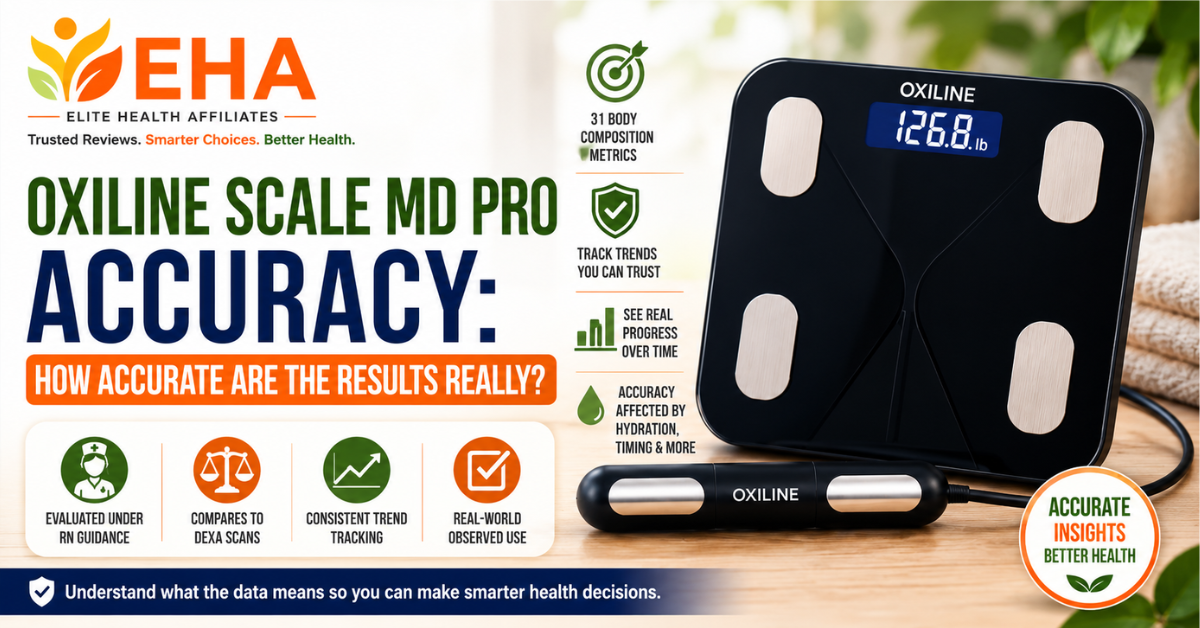
When researching Oxiline Scale MD Pro accuracy, the real question is not whether every body-fat or muscle reading is perfectly exact. Smart scales estimate body composition through bioelectrical impedance analysis, which means hydration, meals, exercise, and the time of day can all affect the numbers. What matters most at home is whether the scale produces consistent, believable trends when it is used under similar conditions.
We evaluated the Oxiline Scale MD Pro through structured, real-world use under registered nurse guidance, with attention to repeat readings, timing, hydration, and how the reported body-composition changes developed over time. The goal was not to claim clinical validation or suggest that the scale replaces a DEXA scan. It was to determine whether the MD Pro gives users practical information they can follow with confidence as part of a regular home-tracking routine.
In this guide, we’ll explain how the scale estimates its 31 body-composition metrics, where its readings are most useful, what can cause them to fluctuate, and how its accuracy compares with professional testing. By the end, you should have a clear understanding of what the Oxiline Scale MD Pro can realistically tell you—and what it cannot.
This post contains affiliate links. If you purchase through them, we may earn a small commission at no extra cost to you.
Table of Contents
Is the Oxiline Scale MD Pro Accurate?
The Oxiline Scale MD Pro is accurate enough for tracking trends at home, but it should not be treated as a clinical measuring device. Weight readings are the most direct measurement, while body fat, muscle mass, visceral fat, body water, metabolic age, and the other reported metrics are estimates calculated through bioelectrical impedance analysis.
That distinction matters because a smart scale can be useful without producing the exact same number you would receive from a DEXA scan or another professional assessment. For most people, the real value comes from seeing whether weight, body fat, muscle, and other measurements are generally moving in the expected direction over several weeks or months.
When the Oxiline Scale MD Pro is used under similar conditions, the results become easier to interpret. A single body-fat reading may move because of hydration, recent exercise, meals, or timing, but longer-term patterns can still provide meaningful insight into progress. The scale is best viewed as a home trend-tracking tool rather than a device for making medical decisions.
For a complete look at its features, setup, app experience, strengths, and drawbacks, read our Oxiline Scale MD Pro Review.
See current pricing, availability, and eligible offers from Oxiline
How the Oxiline Scale MD Pro Measures Body Composition
The Oxiline Scale MD Pro uses bioelectrical impedance analysis, commonly called BIA, to estimate body composition. During a scan, a low-level electrical signal passes through the body through the sensors in the scale and handheld unit. Because muscle, fat, and water conduct that signal differently, the device measures resistance and uses an algorithm to estimate several body-composition values.
The scale combines that electrical response with profile information such as age, height, weight, and sex. From there, it calculates estimates for body fat, visceral fat, muscle mass, body water, bone mass, metabolic age, and other measurements included in the 31-metric report.
The important word is estimate. The Oxiline Scale MD Pro does not directly see or measure every pound of muscle or body fat. It interprets electrical resistance patterns and applies predictive formulas, which is why testing conditions can influence the final result. Used consistently, those estimates can still be useful for following changes, but they should not be mistaken for exact laboratory measurements.
For a broader look at which home scales provide the most useful body-fat trend tracking, read Best Smart Scale for Body Fat Accuracy That Actually Works.
How We Evaluated Oxiline Scale MD Pro Accuracy
We evaluated the Oxiline Scale MD Pro through structured, real-world use under registered nurse guidance. Rather than attempting to perform clinical validation, we focused on whether the scale behaved consistently during normal home use and whether the results formed believable patterns over time.
Measurements were taken under similar conditions, primarily in the morning before eating, with attention to hydration, timing, surface placement, and repeat-reading stability. We also watched how body-fat and visceral-fat trends responded when weight and lifestyle patterns changed in expected ways. This approach helped separate everyday usefulness from clinical precision.
We were not trying to prove that the MD Pro could replace professional testing. We wanted to know whether someone using it regularly at home could follow progress without being misled by constant unexplained swings. What we found was that the scale became more useful when the routine stayed consistent. Day-to-day numbers still moved, especially among the estimated body-composition metrics, but longer-term trends were easier to understand and generally aligned with expected changes.
To see how the scale, handheld sensor, app, and 31 reported measurements perform as part of a normal routine, read Does the Oxiline Scale MD Pro Actually Work?
See the Oxiline Scale MD Pro on Amazon →
What We Observed During Regular Use
The most useful thing we learned was that Oxiline Scale MD Pro accuracy improves as a tracking experience when the routine stays consistent. Weight readings were generally straightforward, while body-fat, muscle, water, and visceral-fat estimates moved more from day to day. Those changes were not always signs that something had gone wrong. In many cases, they reflected the normal sensitivity of bioelectrical impedance analysis to hydration, meals, activity, and timing.
Repeat readings taken under similar conditions were easier to understand than measurements taken randomly throughout the day. When weigh-ins happened in the morning, before eating, and with reasonably similar hydration, the numbers formed more believable patterns. When the routine changed, some of the estimated measurements became noticeably noisier, which reinforced why one isolated reading should not be treated as a final judgment.
The 31 reported measurements also created a learning curve. At first, it is tempting to examine every number and wonder why several moved at once. The experience became more useful when we narrowed the focus to a few meaningful trends, such as weight, body fat, muscle mass, and visceral fat, rather than trying to interpret every metric after every scan.
Oxiline currently offers three smart scale options. For a simpler look at how the three Oxiline models differ in tracking depth, features, and everyday use, read our Oxiline Scale Comparison.
Oxiline Scale MD Pro vs DEXA Scan
A DEXA scan and the Oxiline Scale MD Pro are designed for very different purposes. DEXA uses low-dose X-ray imaging to evaluate fat mass, lean tissue, and bone mass under controlled conditions. The MD Pro uses bioelectrical impedance and predictive algorithms to estimate body composition from the electrical resistance measured during a home scan.
That difference makes DEXA the better option when someone needs a more precise single assessment. It is performed with specialized equipment and is commonly used in medical and research settings. The drawback is that it requires an appointment, costs more than stepping on a home scale, and is not practical for frequent progress checks.
The Oxiline Scale MD Pro cannot match that level of controlled precision, but it offers something a DEXA scan does not: the ability to collect regular readings at home. Someone can weigh daily or several times per week, follow the direction of body-fat and muscle estimates, and see whether the overall pattern changes over time without arranging repeated clinical testing.
The fairest comparison is not whether the MD Pro can replace DEXA—it cannot. The better question is whether its convenience and repeatability make it useful between professional assessments. For many users, the answer is yes, provided they understand that the scale reports estimates rather than direct measurements.
Who Can Rely on the Oxiline Scale MD Pro—and Who Should Look Elsewhere?
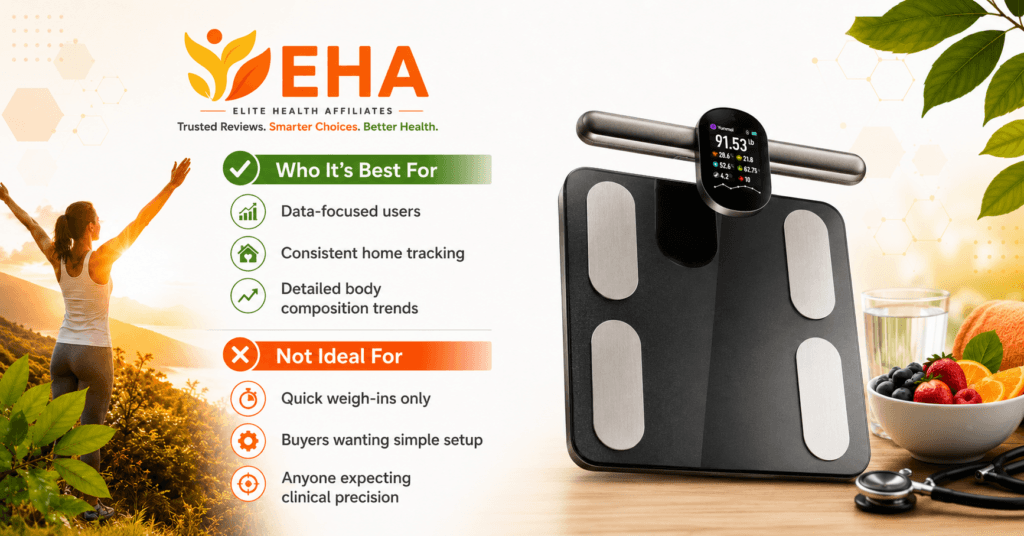
The Oxiline Scale MD Pro is best suited to someone who wants frequent home tracking and is willing to follow a consistent routine. It can be useful for people monitoring long-term changes in weight, body fat, muscle mass, and other estimated measurements, especially when their goal is to understand direction rather than demand exact agreement with professional testing.
It also makes more sense for users who enjoy reviewing detailed data. The handheld sensor and 31 measurements provide a deeper experience than most platform-only scales, but that extra information only adds value when someone is prepared to use the app, compare trends, and avoid overreacting to normal daily fluctuations.
The MD Pro is not the right tool for clinical decisions, diagnosis, or anyone who requires laboratory-level precision from every reading. It may also be more complicated than necessary for someone who mainly wants weight and a basic body-fat trend. In those situations, a simpler model may be easier to use consistently and provide better everyday value.
The bottom line is that the MD Pro works best as a trend-analysis tool, not a single-reading decision device. Users who understand that distinction are much more likely to find the information helpful rather than frustrating.
How to Get More Consistent Readings
The best way to improve Oxiline Scale MD Pro accuracy is to make each weigh-in as comparable as possible. The scale cannot control changes in hydration, meals, exercise, or testing time, so a random afternoon reading may look noticeably different from one taken first thing in the morning. That does not necessarily mean the scale failed or your body composition suddenly changed. It usually means the conditions were different.
We recommend keeping the scale on the same firm, level surface and using it at roughly the same time each day. Morning measurements taken after using the bathroom and before eating, drinking, or exercising are often the easiest to compare. Your feet should be bare and dry, and you should maintain full contact with both the platform electrodes and handheld sensor until the scan finishes.
It also helps to resist repeating the measurement until you receive a number you like. One unusual reading may simply be temporary noise, but several weeks of measurements can reveal whether the overall direction makes sense. The MD Pro becomes much more useful when you judge it by patterns in weight, body fat, muscle, and hydration rather than expecting every daily result to remain perfectly steady.
Accuracy is only part of the buying decision. The Scale MD Pro also needs to provide enough practical value to justify its price and more advanced design. Our complete guide: Is the Oxiline Scale MD Pro Worth It? examines whether those features make it a worthwhile investment.
When a Simpler Oxiline Scale May Make More Sense
The Oxiline Scale MD Pro provides the deepest tracking experience in the lineup, but more information does not automatically make it the best choice for every person. Someone who wants useful body-composition trends without holding a sensor or reviewing 31 measurements may find the Oxiline Scale XS Pro easier to use consistently. It still provides detailed app-based tracking, but the overall experience is more approachable for an ordinary daily routine.
To see whether that balance of features and simplicity better fits your needs, read our Oxiline Scale XS Pro Review.
The Oxiline Scale X Pro takes an even simpler approach. Its current version reports eight measurements and is better suited to someone who mainly wants weight, body-fat trends, and basic connected tracking without paying for more advanced features. It does not provide the same depth as the MD Pro, but that may be an advantage for users who know they will never study dozens of measurements.
For a closer look at its streamlined design and current features, read our Oxiline Scale X Pro Review.
The MD Pro remains the better fit for data-focused users who want segmental estimates and the handheld measurement system. The XS Pro offers the strongest middle ground, while the X Pro is the simpler entry point. Choosing correctly depends less on which model produces the most numbers and more on which one you will realistically keep using.
Pros and Cons of Oxiline Scale MD Pro Accuracy
Pros
- Weight readings are generally the most direct and repeatable measurement
- The handheld sensor adds more contact points than a platform-only scale
- Long-term body-composition trends become easier to interpret with consistent use
- The app stores results and makes changes easier to follow over time
- Thirty-one reported measurements provide a broad view of estimated body composition
- RN-guided observed use focused on repeatability and realistic home performance
- Frequent home measurements are more convenient than repeated professional assessments
Cons
- Body fat, muscle, visceral fat, and other composition readings remain estimates
- Hydration, meals, exercise, sodium intake, and timing can affect individual results
- The MD Pro cannot match the controlled precision of a DEXA scan
- Thirty-one measurements may create more information than some users need
- Inconsistent weighing routines can produce confusing fluctuations
- The scale is not intended for diagnosis or clinical decision-making
- Buyers expecting exact agreement with professional testing may be disappointed
The Oxiline Scale MD Pro performs best when accuracy is defined realistically. It can provide stable weight readings and useful direction across estimated body-composition trends, but it cannot eliminate the normal limitations of bioelectrical impedance technology. Used consistently, it can help someone understand whether progress is generally moving in the right direction. Used randomly and judged one measurement at a time, the same scale can feel much less dependable.

Save 10% with code EHA10 on eligible official-site orders only
Frequently Asked Questions About Oxiline Scale MD Pro Accuracy
How accurate is the Oxiline Scale MD Pro for weight?
Weight is the most direct measurement produced by the Oxiline Scale MD Pro and is generally more stable than its estimated body-composition results. As with any digital scale, the device should remain on a firm, level surface and be used in the same location whenever possible. Moving it between hard flooring, carpet, or uneven surfaces can create unnecessary variation before hydration or other body-composition factors even come into play.
Why does my body-fat percentage change from one day to the next?
The Oxiline Scale MD Pro estimates body fat through bioelectrical impedance analysis, so the reading can respond to changes in hydration, meals, sodium intake, carbohydrate intake, recent exercise, and the time of day. A noticeable movement does not necessarily mean you gained or lost that amount of body fat overnight. It may simply reflect a temporary change in the way the electrical signal traveled through your body.
The most useful response is not to keep stepping back on the scale until a preferred number appears. Continue using it under similar conditions and watch whether the broader trend becomes clearer over several weeks. Daily fluctuations are normal, while the longer-term direction provides the more meaningful information.
Does hydration affect Oxiline Scale MD Pro accuracy?
Yes. Hydration is one of the most important variables affecting bioelectrical impedance readings because water conducts electricity differently than body fat. Dehydration may make a body-fat estimate appear higher, while increased hydration can sometimes push the estimate lower.
You do not need to maintain an identical hydration level every day, which would be unrealistic. The goal is simply to measure under reasonably similar conditions, rather than comparing a morning reading with one taken after a large meal, strenuous workout, or unusually high fluid intake.
Can the Oxiline Scale MD Pro accurately measure visceral fat?
The scale reports a visceral-fat estimate based on electrical resistance, personal profile information, and predictive algorithms. It does not directly observe or image fat surrounding the internal organs, so the result should not be treated as a diagnosis or exact clinical measurement.
The visceral-fat reading may still be useful as a trend when it is followed consistently. What matters is whether the reported direction remains believable over time, not whether one number can replace professional imaging or medical evaluation.
Is the Oxiline Scale MD Pro as accurate as a DEXA scan?
No. A DEXA scan uses specialized imaging to evaluate body composition under controlled conditions, while the Oxiline Scale MD Pro estimates body composition through bioelectrical impedance. DEXA is the more appropriate option when precise single-point assessment is needed.
The MD Pro serves a different purpose. It allows users to collect frequent readings at home and follow changes without repeatedly scheduling or paying for professional testing. That convenience can make it useful for ongoing progress monitoring, even though it cannot match DEXA for clinical precision.
How often should I use the Oxiline Scale MD Pro?
Daily use can help create a detailed trend, but weighing every day is not required. Several readings per week may be enough for someone who prefers a less frequent routine. Consistency matters more than frequency, so a predictable schedule is usually more valuable than stepping on the scale at random times.
People who weigh daily should avoid reacting emotionally to every movement. Looking at weekly averages and longer-term charts can make the normal fluctuations easier to understand and prevent one unusual result from overshadowing the broader pattern.
Can the Oxiline Scale MD Pro be used for medical decisions?
No. The Oxiline Scale MD Pro is intended for home body-composition and progress tracking, not diagnosis or clinical decision-making. Someone who needs medical-grade measurements, is monitoring a health condition, or sees a concerning unexplained change should discuss it with an appropriate healthcare professional rather than relying on a smart-scale estimate.
EHA Verdict

The Oxiline Scale MD Pro is sufficiently consistent for home trend tracking when it is used correctly, but its accuracy needs to be judged according to what the device actually does. It measures weight directly and estimates most of its other 30 reported metrics through bioelectrical impedance, which means body fat, muscle, water, visceral fat, and similar values will naturally respond to changes in testing conditions.
During our observed use under registered nurse guidance, the scale was most useful when measurements were taken as part of a repeatable routine. Morning testing, consistent surface placement, and attention to hydration made the resulting patterns easier to understand. Individual readings still moved, but the longer-term trends were more informative than any single body-fat percentage or metabolic-age estimate.
We would not recommend the Oxiline Scale MD Pro to someone who expects every result to match a DEXA scan or professional body-composition assessment. That is not a realistic expectation for a home BIA scale. We would recommend it to data-focused users who understand that the numbers are estimates and want a convenient way to follow progress between professional evaluations.
The EHA verdict is that Oxiline Scale MD Pro accuracy is strongest as trend accuracy, not clinical precision. When used with that expectation, the scale can provide meaningful feedback about the direction of weight and estimated body-composition changes. When treated as a diagnostic instrument or judged by isolated daily readings, it is much more likely to create confusion.
Where to Buy the Oxiline Scale MD Pro
The Oxiline Scale MD Pro is available from both the official Oxiline website and Amazon. Buying directly from Oxiline may be the better fit for shoppers who want manufacturer support, official-site promotions, and the opportunity to use our discount code. Amazon may appeal more to people who prioritize familiar checkout, shipping options, customer feedback, and Amazon’s current return process.
The terms may differ between the two sellers, so compare the current warranty, return policy, price, and delivery estimate before choosing. Do not assume that an Amazon purchase automatically includes the same manufacturer protections or promotional offers as an order placed directly through Oxiline.

Buy Direct and Save on the Oxiline Scale MD Pro
Use code EHA10 at checkout to save 10% on eligible official-site orders
Prefer Ordering the Oxiline Scale MD Pro on Amazon?
Compare current pricing, shipping, availability, and customer reviews
Explore More Smart Scale Reviews and Guides
The Oxiline Scale MD Pro can be useful for detailed home trend tracking, but it is not the only option. Some users will prefer the deeper measurements and handheld sensor, while others may get better everyday value from a simpler model they are more likely to use consistently.
For more RN-supervised reviews, accuracy guides, product comparisons, and practical buying advice, explore our complete Smart Scale Reviews and Guides.