
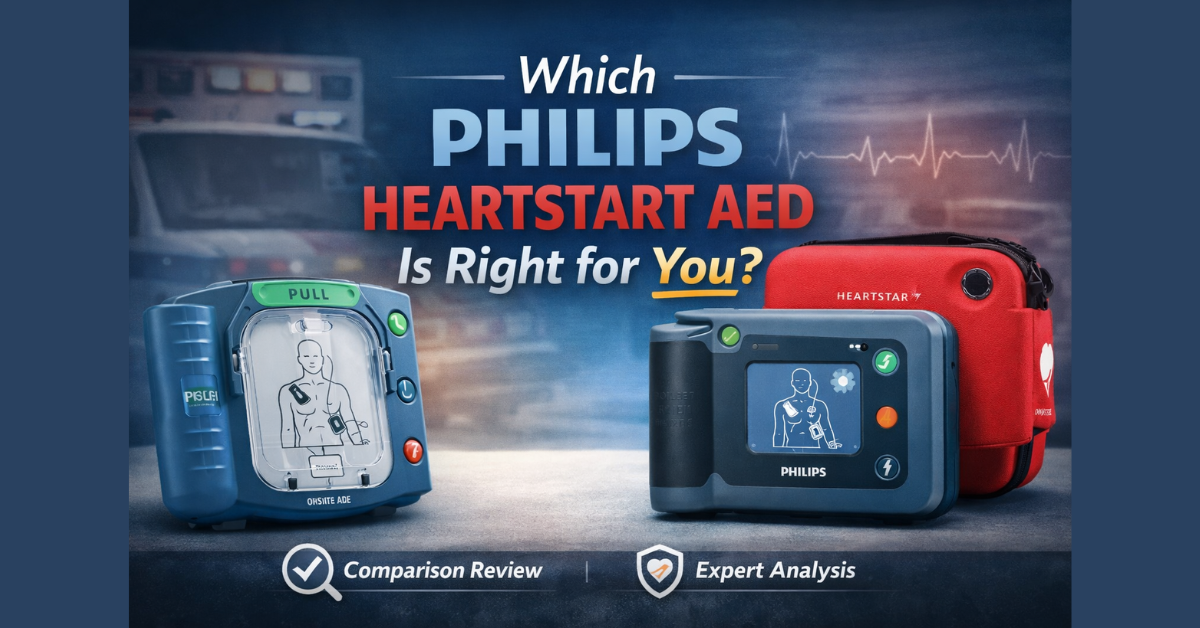
Philips HeartStart OnSite AED devices are designed to make lifesaving action possible for everyday people—not just medical professionals. When sudden cardiac arrest strikes, having a reliable, easy-to-use automated external defibrillator on hand can mean the difference between life and death.
That’s why the Philips HeartStart OnSite series is widely trusted for home use, as well as in workplaces, schools, gyms, churches, and public spaces.
Within this lineup, the M5066A and M5068A are two of the most commonly purchased models—but they’re not identical. While both offer the same core lifesaving technology Philips is known for, small differences in features, accessories, and long-term value can make one a better fit depending on your environment and preparedness goals.
In this comparison, all content is supervised by an RN, ensuring the information focuses on real-world safety, usability, and preparedness—not just technical specs.
We’ll break down the key differences between the Philips HeartStart OnSite AED M5066A and M5068A, explain what actually matters in real-world use, and help you decide which model makes the most sense for your home or organization—without unnecessary jargon or hype.
This post contains affiliate links. If you purchase through them, we may earn a small commission at no extra cost to you.
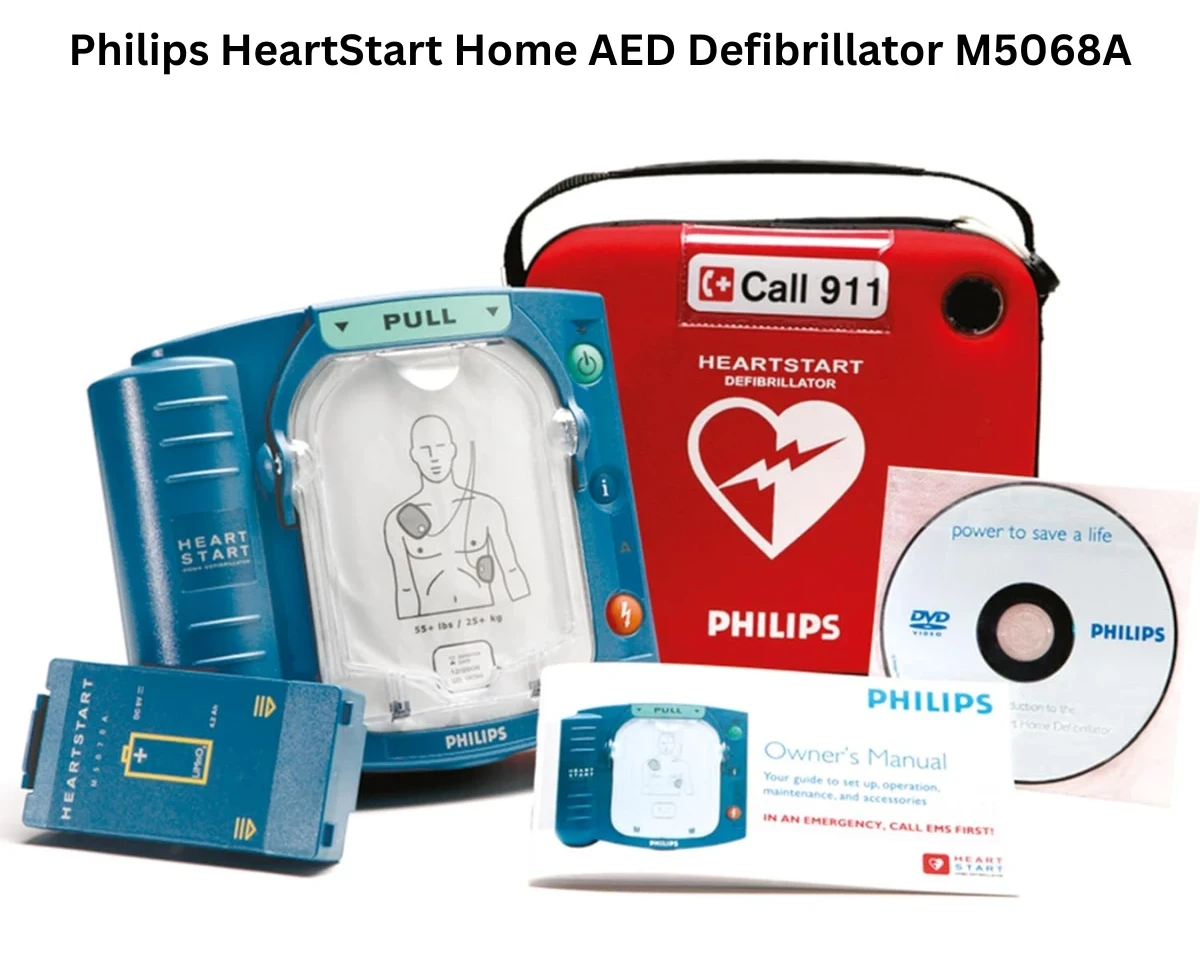
View pricing and official product details.
Table of Contents
What the Philips HeartStart OnSite AED Is
The Philips HeartStart OnSite AED is a portable automated external defibrillator designed for use by non-medical individuals in emergency situations. It is intended for home use and public-access settings, allowing everyday people to respond quickly during a sudden cardiac arrest event before professional medical help arrives.
Unlike manual defibrillators used in hospitals, the HeartStart OnSite AED requires no prior medical training. It guides the user through each step of the response with clear voice prompts, visual indicators, and built-in safety checks, helping reduce hesitation and user error during a high-stress situation.
What the Philips HeartStart OnSite AED Does
The Philips HeartStart OnSite AED works by analyzing the heart’s rhythm and determining whether a defibrillation shock is needed. If a shockable rhythm is detected, the device provides clear instructions and delivers a controlled electrical shock designed to help restore a normal heart rhythm.
Key functions include:
- Automatic heart rhythm analysis to prevent unnecessary shocks
- Step-by-step voice guidance throughout the rescue process
- Adaptive instructions that adjust based on the user’s actions
- Safety safeguards that only allow shock delivery when appropriate
By combining intelligent monitoring with simple guidance, the Philips HeartStart OnSite AED helps bridge the critical time gap between cardiac arrest and the arrival of emergency responders—whether used in the home or in a shared public environment.
How We Tested the Philips HeartStart OnSite AED M5066A and M5068A
To evaluate the Philips HeartStart OnSite AED, we focused on real-world usability and safety rather than administering shocks. All testing was supervised by an RN, ensuring accuracy and safety at every step.
We examined both models in simulated home and workplace scenarios, assessing:
- Ease of setup and readiness checks
- Clarity and effectiveness of voice prompts
- Pad placement guidance using training pads
- Portability and storage options
- Battery status visibility and replacement procedures
We also tested routine maintenance features, such as self-tests and accessory replacement, to determine long-term usability. By simulating emergency conditions, we could see how quickly someone with no prior AED experience could respond, and how each model’s differences affect real-world performance.
What We Discovered
During our evaluation of the Philips HeartStart OnSite AED M5066A and M5068A, several important differences and similarities became clear:
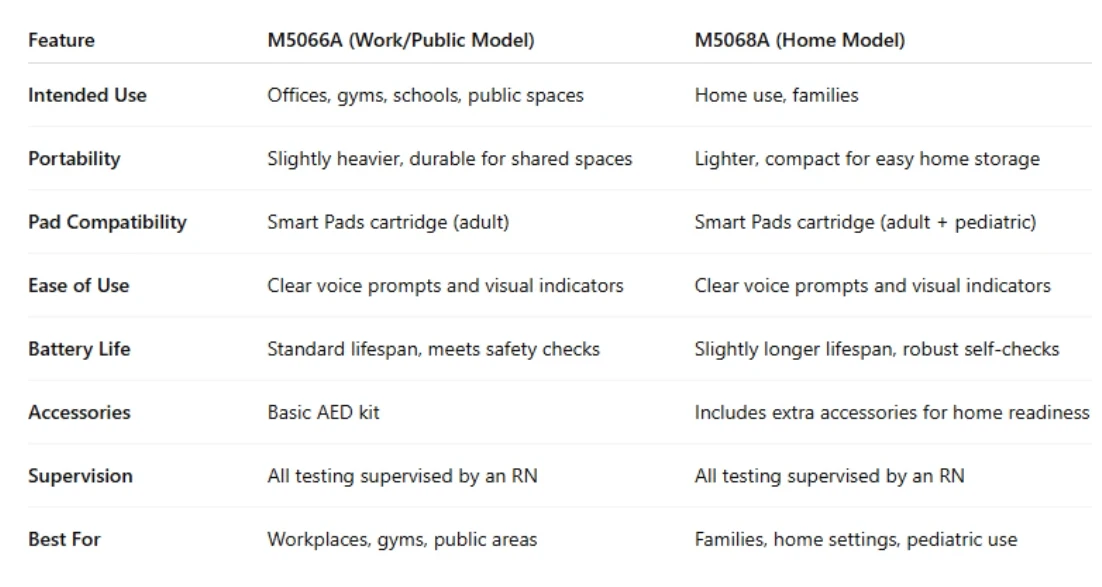
- Ease of Use: Both models are extremely user-friendly, with clear voice prompts and visual indicators. A first-time user could confidently follow the steps under supervision.
- Portability and Design: The M5066A is ideal for workplaces or public spaces, while the M5068A, labeled as the home model, is slightly lighter and designed for easy storage in household settings.
- Pad Compatibility: Both units use the same Smart Pads cartridge, but the M5068A’s cartridge includes pediatric options, making it more versatile for family use at home.
- Battery Life and Maintenance: The M5068A has a slightly longer battery lifespan and more robust self-check features, while the M5066A still meets all standard safety checks.
- Environment Suitability: Both models are suitable for home or public use, but the M5068A’s features and lighter design make it the preferred choice for home settings, while the M5066A is better suited for offices, gyms, or other shared spaces.
Overall, we found that both AEDs deliver the same lifesaving core technology, but your choice may depend on environment, user familiarity, and accessory needs.
Who These Are Best For
Choosing between the Philips HeartStart OnSite AED M5066A and M5068A largely depends on where and by whom the device will be used.
- M5068A – Home Model:
- Ideal for families and homeowners looking for a compact, easy-to-store AED.
- Perfect for households with children, thanks to the pediatric Smart Pads option.
- Suitable for anyone who wants peace of mind at home, without the need for professional training.
- M5066A – Workplace/Public Model:
- Best for offices, gyms, schools, and public facilities.
- Designed for frequent or multi-user environments, with slightly heavier-duty accessories.
- Suitable for locations where multiple people may need access in an emergency.
Both models are simple to use and reliable, making them a solid choice for anyone who wants to be prepared for sudden cardiac arrest, but the M5068A is tailored for home environments, while the M5066A excels in shared or public spaces.
Philips HeartStart OnSite AED: M5066A vs M5068A Comparison
Pros and Cons
Philips HeartStart OnSite AED M5068A (Home Model)
Pros
- Designed for home use, compact and easy to store
- Includes pediatric Smart Pads option, useful for families
- Longer battery life and robust self-checks for ongoing readiness
- Clear voice guidance makes it accessible for first-time responders
- Lightweight and approachable for non-clinical users
Cons
- Slightly less rugged than the M5066A for heavy public use
- Fewer workplace-oriented accessories included
Philips HeartStart OnSite AED M5066A (Work/Public Model)
Pros
- Durable and versatile for shared spaces like offices and gyms
- Same lifesaving core technology as the home model
- Clear, step-by-step voice prompts support confident use
- Includes accessories suited for multiple users/environments
Cons
- No pediatric pads included by default (adult-only Smart Pads)
- Slightly heavier and bulkier, which may be less ideal for home storage
Shared Pros (Both Models)
- Extremely user-friendly — ideal for non-medical first responders
- Automatic rhythm analysis prevents unnecessary shocks
- Self-tests and readiness checks keep the device prepared
- Safe and intuitive navigation with prompts and visual cues
Shared Cons (Both Models)
- AEDs require periodic pad and battery replacement (standard for all AEDs)
- Not intended to replace formal CPR training, though they strongly support it
Summary Recommendation
Both the Philips HeartStart OnSite AED M5066A and M5068A deliver reliable, lifesaving technology in an easy-to-use package.
- Choose the M5068A (Home Model) if you want a compact AED for home use, with pediatric options and longer battery life, making it ideal for families and household preparedness.
- Choose the M5066A (Work/Public Model) if your focus is a shared or public environment, such as an office, gym, school, or community space, where durability and workplace-ready accessories matter most.
Both devices are safe, intuitive, and backed by Philips’ trusted technology, ensuring that anyone—even a first-time user—can respond confidently during a sudden cardiac emergency.
For a more detailed look at distributor options, warranties, and value comparisons, see our Best Portable AED Defibrillator: Top Models & Where to Buy full review.
Frequently Asked Questions
Q: Can anyone use the Philips HeartStart OnSite AED?
A: Yes. Both the M5066A and M5068A are designed for non-medical users, with clear voice prompts and visual cues to guide you through the process safely.
Q: What’s the difference between the M5066A and M5068A?
A: The M5068A is labeled as the home model, lighter, and includes pediatric Smart Pads, making it ideal for families. The M5066A is suited for workplaces or public areas, with slightly heavier-duty accessories and adult-only pads by default.
Q: Do these AEDs require training?
A: Formal CPR training is recommended, but these devices are fully usable without prior experience. The voice-guided instructions help any first-time responder act confidently.
Q: How often do the pads and batteries need replacement?
A: Both AEDs perform regular self-checks. Pads typically last 2–4 years, and batteries vary by model, generally lasting several years or until the device indicates replacement is needed.
Q: Can these AEDs be used on children?
A: Yes, but only the M5068A (Home Model) comes with pediatric Smart Pads included. The M5066A is adult-only by default.
Q: Are these AEDs suitable for home use?
A: Absolutely. The M5068A is specifically designed for home use, while the M5066A works best in offices or public spaces. Both are safe and easy to store.
Where to Buy the Philips HeartStart OnSite AED Safely
When it comes to purchasing an AED, it’s important to buy safely from a reputable source. Both the M5066A (Work/Public Model) and the M5068A (Home Model) are available from HeartSmart.com and Amazon, but there are a few reasons why HeartSmart.com is the preferred option:
- Frequent Discounts and Specials: HeartSmart.com often offers exclusive promotions, bundle deals, and seasonal discounts, helping you get the AED you need at a better value.
- Trusted Source: HeartSmart.com is a reliable, authorized retailer of Philips AEDs, ensuring you receive genuine devices with proper accessories.
- Professional Support: Their team provides guidance, warranty support, and answers to product questions, making the purchase process simple and reassuring.
- Convenient Options: You can order online and have the AED shipped directly to your home or workplace, fully prepared for setup.
Amazon is also a legitimate option for buying these AEDs, but pricing and availability can vary, and HeartSmart.com frequently has better deals, packages, and dedicated customer support.
For peace of mind and safe purchasing, we recommend getting your Philips HeartStart OnSite AED from HeartSmart.com, where you can take advantage of discounts, bundles, and professional guidance, ensuring your home or organization is ready when it matters most.
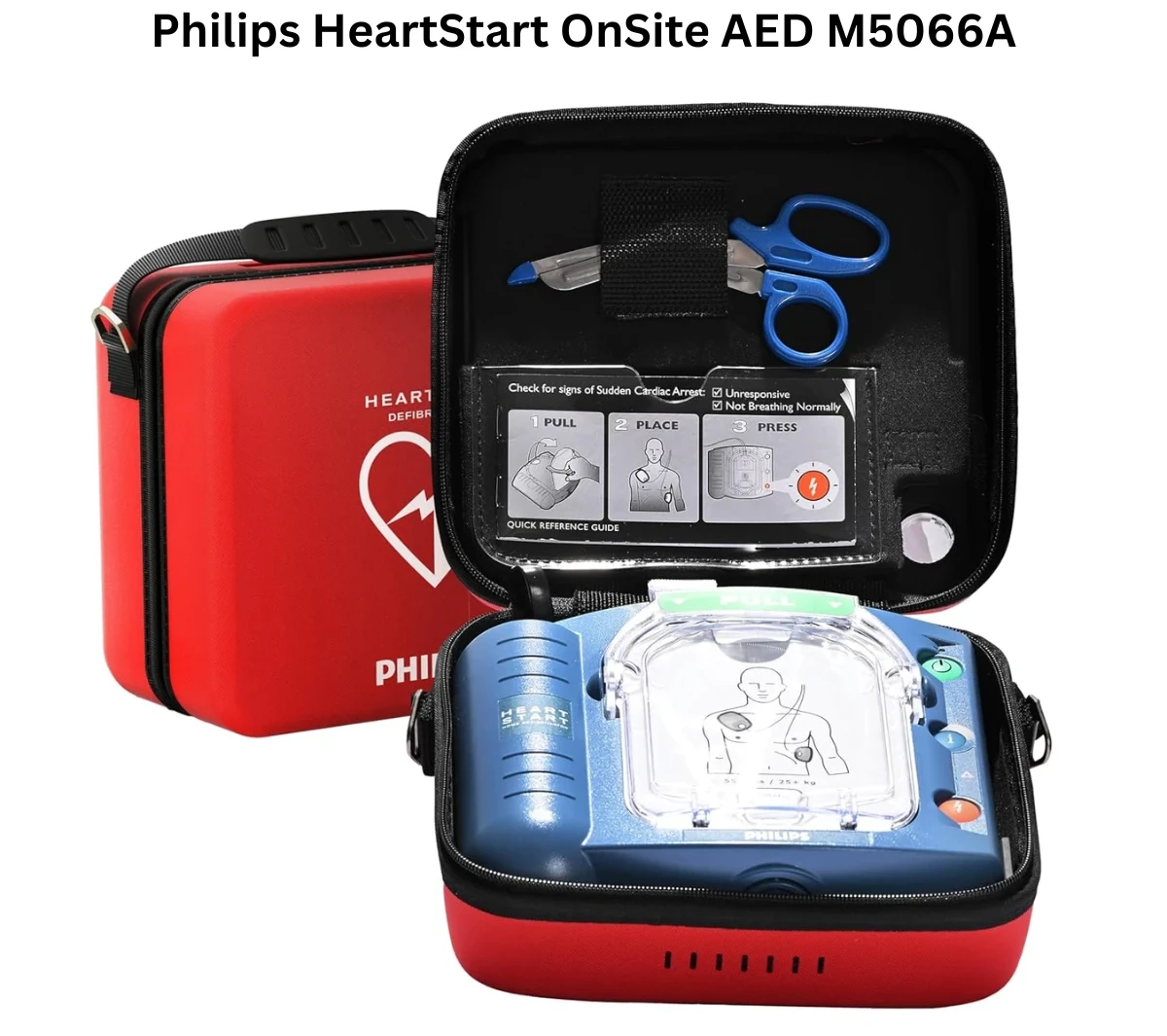
View pricing and order directly from the official HeartSmart website.
Final Thoughts on the Philips HeartStart OnSite AED
Both the M5066A and M5068A bring lifesaving AED technology into the hands of everyday users. The M5068A is tailored for home use, with pediatric options and a compact design, while the M5066A excels in workplaces and public spaces with durable accessories for multiple users.
With clear voice prompts, automatic rhythm analysis, and easy maintenance, either model provides confidence and readiness in an emergency. For safe, reliable purchasing—often with discounts and bundle deals—HeartSmart.com is our recommended source but they are also available on Amazon.
Choosing the right model depends on your environment and needs, but both make it easier to act quickly and effectively when it matters most.
Thanks for reading, we look forward to your visit at EliteHealthAffiliates.com – Your Go-To Authority for Health & Wellness