
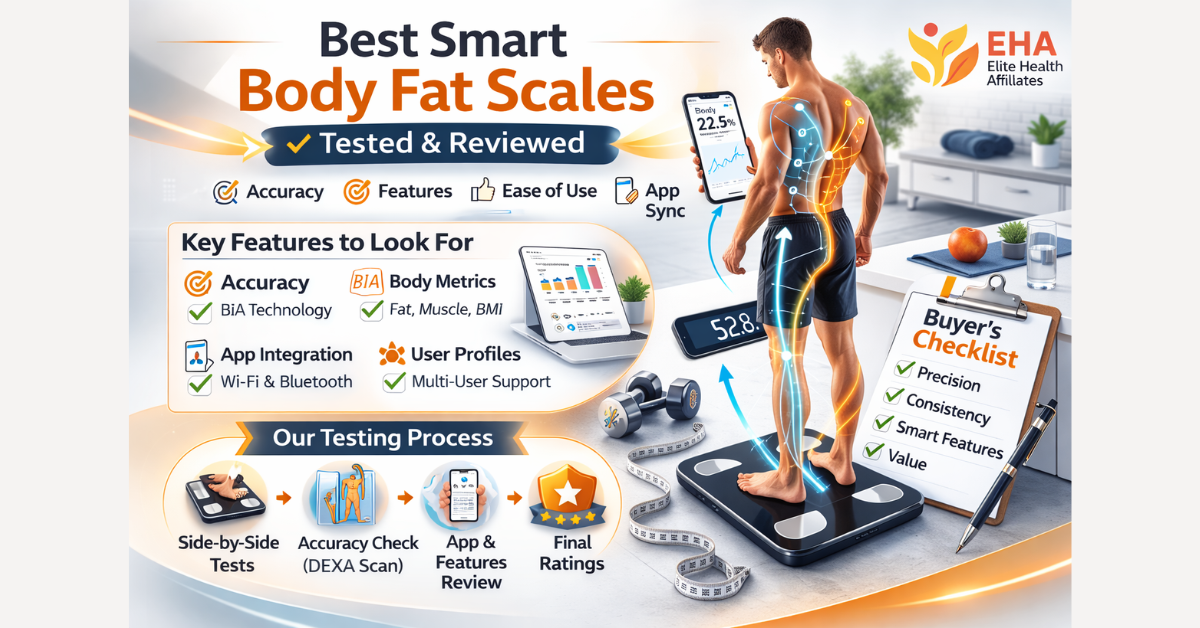
Finding the best smart scale for body fat isn’t about flashy apps or long feature lists — it’s about accuracy you can trust. Nearly every smart scale promises precise body fat readings, muscle tracking, and advanced body composition data. But in real-world use, many fall short where it matters most: consistent, repeatable measurement.
If you’re adjusting your diet, training program, or weight-loss plan based on body fat trends, even small inaccuracies can create misleading progress signals. A scale that jumps several percentage points overnight isn’t helping — it’s creating noise. And when you’re tracking long-term results, reliability is everything.
So, what actually separates the marketing hype from a scale that delivers real body fat accuracy? The difference comes down to sensor precision, algorithm calibration, and measurement stability over time — not big promises on the box.
We evaluated how leading models perform across repeated weigh-ins, how stable their readings remain, and whether the data is dependable enough for serious tracking. One model clearly stood out — but understanding why matters before you decide.
This post contains affiliate links. If you purchase through them, we may earn a small commission at no extra cost to you.
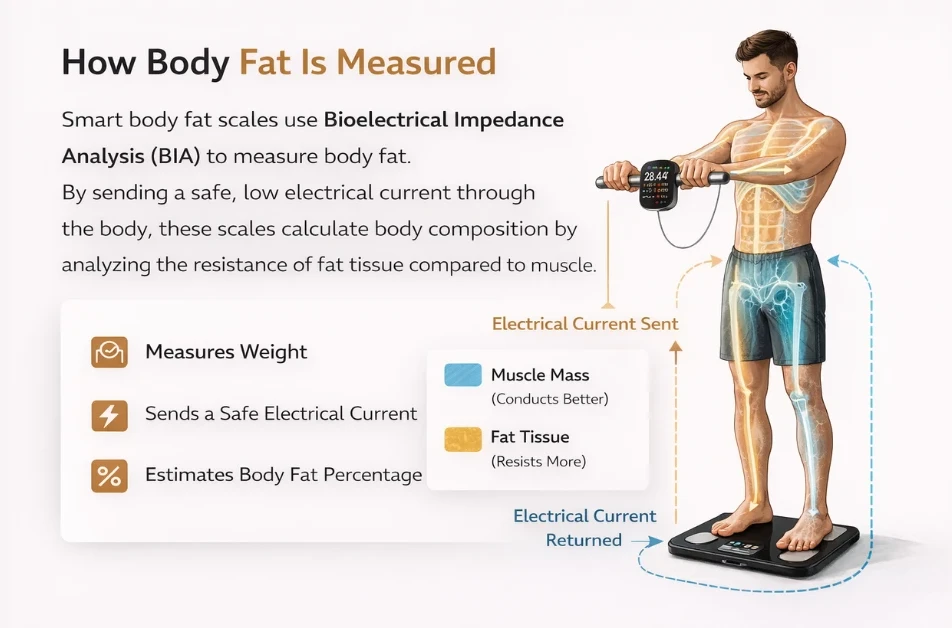
Table of Contents
What Makes the Best Smart Scale for Body Fat Accurate?
Not all smart scales measure body fat the same way. Most rely on bioelectrical impedance analysis (BIA) — a technology that sends a low electrical signal through your body to estimate fat percentage based on resistance levels. While the science behind BIA is legitimate, the quality of the sensors, calibration algorithms, and signal processing determines how accurate the final number actually is.
The best smart scale for body fat isn’t necessarily the one with the most features — it’s the one that delivers consistent readings under the same conditions. True accuracy isn’t about matching a single lab test once. It’s about producing stable, repeatable measurements day after day so trends are meaningful.
Several factors directly impact body fat accuracy, including hydration levels, foot placement, electrode design, and how well the scale’s internal algorithm accounts for variables like age, height, and muscle distribution. Lower-quality models often struggle here, resulting in dramatic fluctuations that don’t reflect real physiological change.
If you’re serious about tracking progress, the goal isn’t perfection — it’s reliable trend data you can trust over time.
How We Tested Smart Scales for Body Fat Accuracy
To determine the best smart scale for body fat, we focused on what actually matters: consistency, stability, and repeatability. Each scale was tested under the same controlled conditions — same time of day, similar hydration state, and multiple consecutive weigh-ins — so we could isolate true measurement behavior.
Since most smart scales use bioelectrical impedance analysis (BIA), some variation is expected. But excessive swings often indicate weaker calibration or lower-grade sensor systems. We looked for scales that minimized daily variance and delivered tight, repeatable body fat readings over time.
In our testing, we compared several popular models, including:
- Withings Body+ — a well-known consumer favorite with polished app integration
- Etekcity Smart Body Weight Scale — a budget-friendly option with broad distribution
- Garmin Index S2 — a strong choice for ecosystem users, especially fitness-focused
- Renpho and Fitbit smart scales — common picks with varied consistency in prior tests
- Oxiline Scale MD Pro
We evaluated each model for:
- Sensor quality and electrode design
- Number of consecutive tests with stable body fat output
- Long-term trend reliability over several days
- App data clarity and consistency
The goal wasn’t to hit a perfect body fat percentage every time — no consumer smart scale can match lab-grade diagnostics — but to find one that produced dependable trends you can act on.

What We Found — And Why the Oxiline Scale MD Pro Stood Out
Most scales we tested performed similarly on basic weight measurement. But when it came to body fat accuracy over repeated tests, differences became clear.
Some popular competitors showed wider fluctuations in body fat percentage. For example:
- The Etekcity Smart Body Weight Scale often showed 3–5% swings between back-to-back measurements, even under controlled conditions — making trends hard to trust.
- The Withings Body+, while strong on weight stability and hydration estimates, still displayed noticeable inconsistency in body fat readings across sessions.
- The Garmin Index S2 delivered solid weight and water tracking, but body fat readings shifted more widely than we’d consider reliable for long-term progress tracking.
In contrast, the Oxiline Scale MD Pro produced much tighter body fat consistency across multiple readings. Where others jumped significantly, Oxiline’s output stayed within a narrower range — exactly what you want when tracking progress over weeks or months.
Beyond raw stability, Oxiline’s sensor design and algorithm calibration appeared better tuned for real-world use, producing sensible trend lines rather than sudden spikes or drops. Combined with a clear companion app that makes trends easy to follow, this resulted in a more dependable tracking experience overall.
It’s this combination of measurement stability and practical usability that ultimately separated the Oxiline Scale MD Pro from other well-known smart scales in our testing.
If you’re specifically evaluating how accurate the Oxiline Scale MD Pro is compared to medical-grade devices, we’ve published a full accuracy breakdown here.
Key Features That Drive Body Fat Accuracy
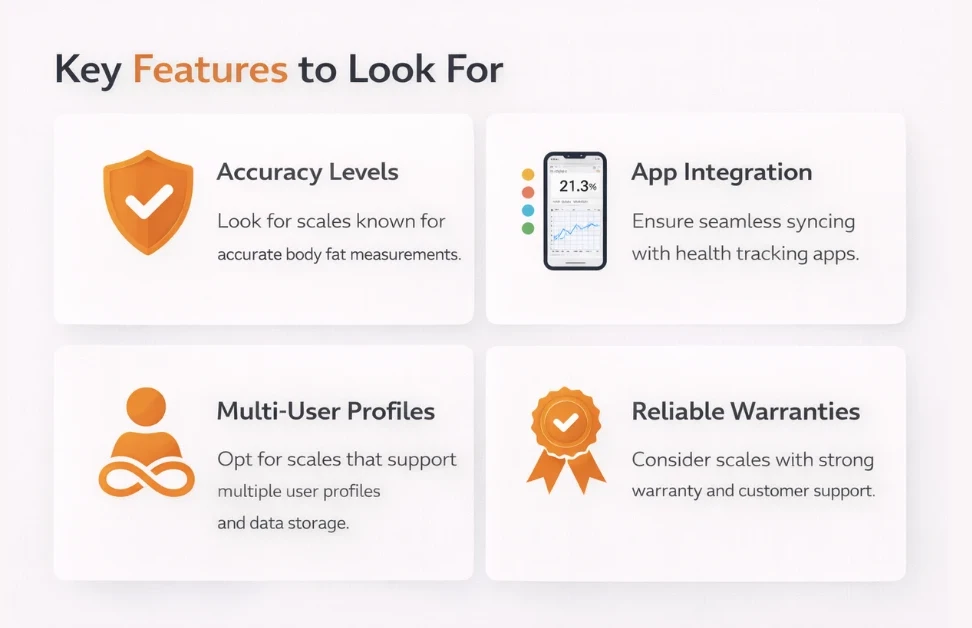
If you’re looking for the best smart scale for body fat accuracy, specific design and technology elements matter more than flashy bells and whistles. Below are the core features we looked for — and the ones that helped the Oxiline Scale MD Pro rise above the rest:
Precision Sensor Design
The foundation of accurate body composition measurement is sensor quality and layout. High-grade electrodes with good contact points reduce signal interference and improve the consistency of bioelectrical impedance readings. Poor sensor design often shows up as erratic body fat percentages in repeated tests.
Advanced Calibration Algorithms
Raw impedance data means nothing without effective processing. The best smart scales use well-tuned algorithms that account for variables like age, height, gender, and even hydration levels. This improves the reliability of the output and reduces day-to-day noise.
Consistent Measurement Stability
A truly accurate scale doesn’t deliver perfect numbers — it delivers repeatable numbers. Stability over multiple tests under the same conditions lets you trust trends instead of random spikes. This is arguably more important than matching a single lab result.
Clear and Insightful App Integration
A good app doesn’t just sync data — it provides clear trend visuals, reasonable variance markers, and actionable tracking insights. Scales with cluttered or misleading apps often underdeliver even if the hardware is decent.
Multi-User Recognition and Profile Accuracy
Because body composition varies widely by individual, reliable user profile distinction is important. The top scales correctly recognize and assign measurements to the right person without confusion — which is essential for tracking over time.
Data Consistency Across Time
Long-term tracking is where average smart scales struggle. The best performers maintain consistent readings over days and weeks, enabling meaningful progress evaluation rather than guessing whether changes are real.
Comfortable, Safe BIA Signals
While body composition technology like BIA is generally safe, better scales balance signal strength and user comfort — delivering readings without uncomfortable tingling or inconsistent impedance responses.
Why These Features Matter
It’s one thing to call a scale “accurate” in marketing language. It’s another to produce consistent, predictable body fat measurements session after session. The scales that succeed here don’t rely on a single standout component — they combine high-quality sensors, thoughtful software, stable measurement behavior, and user-friendly reporting. That combination is what makes a smart scale accurate in practice instead of just in promise.
Buyer’s Checklist — What to Look for in a Smart Scale
Use this checklist before choosing a smart scale to make sure you’re getting accurate and consistent body fat readings — not just flashy features.
1. Consistent Body Fat Readings
The most important factor is stability. Step on the scale twice under the same conditions — the number shouldn’t swing wildly. Small variations are normal. Large jumps are not.
2. Reliable Trend Tracking
A good scale helps you see progress over time. Look for steady trend lines instead of random spikes or drops from day to day.
3. Clear, Easy-to-Read App
The app should make your data simple to understand. Clean charts and straightforward tracking are more useful than cluttered dashboards.
4. Accurate User Recognition
If more than one person uses the scale, it should correctly recognize who’s standing on it and save the right data to the right profile.
5. Stable, Solid Build
The scale should feel firm and balanced under your feet. A wobbly platform can affect measurements.
6. Reliable Syncing
Your data should transfer quickly and consistently to your phone. Missed syncs interrupt tracking and make long-term progress harder to follow.
7. Realistic Expectations
No smart scale replaces medical testing. The goal isn’t a perfect number — it’s dependable readings you can track over time.

Quick Buyer Summary
✔ Gives consistent body fat readings
✔ Doesn’t jump around from one weigh-in to the next
✔ Easy-to-read display and simple app
✔ Tracks progress clearly over time
✔ Recognizes the right user
✔ Syncs reliably with your phone
✔ Feels solid and stable to stand on
Why the Oxiline Scale MD Pro Stood Out
After testing multiple smart scales under controlled conditions, one model consistently separated itself from the rest — the Oxiline Scale MD Pro.
While most scales handled basic weight measurement well, the real separation showed up in body fat tracking stability and consistency — the two factors that matter most when evaluating the best smart scale for body fat.
What set the Oxiline Scale MD Pro apart was its ability to deliver measurements that stayed close together across repeated weigh-ins. Instead of producing large swings in body fat percentage from one session to the next — something we observed with several other popular models — the Oxiline readings remained within a much tighter and more predictable range under the same conditions.
That level of consistency matters.
When body fat readings jump unpredictably, it becomes difficult to determine whether changes reflect real progress or simple measurement noise. The Oxiline Scale MD Pro produced trend data that felt logical, stable, and repeatable rather than erratic.
Beyond repeatable body fat output, it also performed well in several supporting areas.
It delivered steady trend tracking over multiple days, reinforcing confidence in long-term progress data.
It demonstrated reliable multi-user recognition, consistently assigning results to the correct profile.
The companion app provided clear, easy-to-read progress charts, making ongoing tracking practical instead of confusing.
And from a hardware standpoint, the scale feels solid and stable underfoot, which contributes to consistent measurement behavior.
No consumer smart scale replaces medical-grade testing. But compared to well-known alternatives — including models from Garmin, Withings, and Etekcity — the Oxiline Scale MD Pro delivered more dependable body fat trends across repeated testing sessions.
That combination of measurement stability, repeatability, and practical usability is what ultimately made it stand out.
While the MD Pro stood out in our testing, model differences can matter depending on your tracking priorities.
If you’re deciding between multiple Oxiline models, our Oxiline Scales: Detailed Comparison for Smarter Wellness Tracking guide breaks everything down side by side.
How the Oxiline Scale MD Pro Compares at a Glance
When evaluating the best smart scale for body fat, consistency and stability matter more than feature lists. Here’s how the Oxiline Scale MD Pro performed compared to other well-known models we tested:
- More stable body fat readings than Etekcity — fewer percentage swings between back-to-back weigh-ins.
- Tighter measurement ranges than Garmin Index S2 under identical testing conditions.
- More consistent long-term trend behavior than Withings Body+, particularly for body fat tracking.
- Stronger repeatability across multiple sessions, reducing noise in progress tracking.
- Clearer trend presentation in the companion app, making changes easier to interpret.
While all major smart scales rely on similar BIA technology, the difference comes down to measurement stability and algorithm consistency over time — and that’s where the Oxiline Scale MD Pro separated itself.
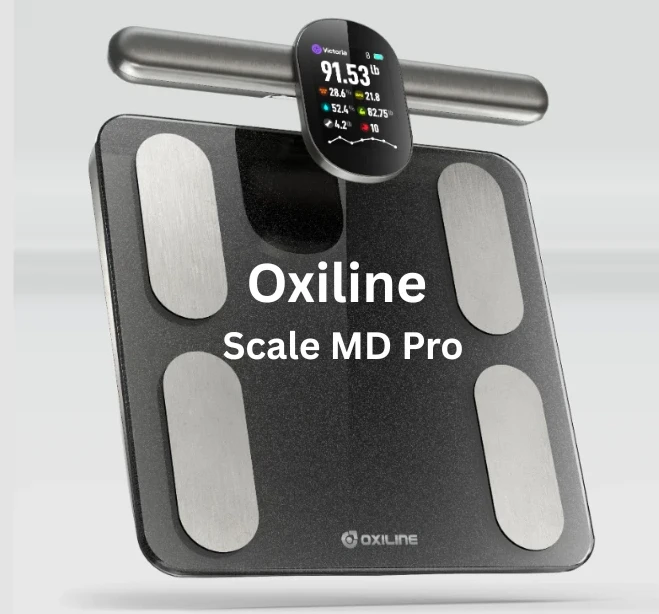
For full testing results and detailed feature analysis, read our complete Oxiline Scale MD Pro: 31 Metrics for Powerful Health Insights review.
Frequently Asked Questions About Smart Scale Body Fat Accuracy
How accurate are smart scales for measuring body fat?
Most smart scales use bioelectrical impedance analysis (BIA) to estimate body fat percentage. While they are not as precise as clinical tools like DEXA scans, higher-quality models can provide consistent and reliable trend data when used under similar conditions. The key isn’t perfect accuracy — it’s repeatability over time.
Why does my body fat percentage change from day to day?
Daily fluctuations are common. Hydration levels, recent exercise, sodium intake, and even time of day can affect readings. That’s why the best smart scale for body fat should deliver stable measurements under consistent conditions rather than dramatic percentage swings.
Can a smart scale replace a DEXA scan?
No consumer smart scale replaces medical-grade testing. However, a well-calibrated model can provide dependable trend tracking that helps you monitor progress between professional assessments. For most users, consistent home tracking is more practical than occasional lab testing.
What makes one smart scale more accurate than another?
Accuracy differences often come down to sensor quality, algorithm calibration, and measurement stability. Scales that produce repeatable readings across multiple sessions tend to be more useful for long-term body composition tracking.
Final Thoughts
Finding the best smart scale for body fat ultimately comes down to one thing: measurement consistency you can trust. Flashy features and long metric lists mean very little if body fat readings fluctuate unpredictably from one session to the next.
In our testing, the biggest differentiator wasn’t the number of tracked metrics — it was stability over time. A scale that produces repeatable readings under consistent conditions gives you usable trend data, and trend data drives smarter decisions around nutrition, training, and long-term health goals.
While no consumer smart scale replaces clinical testing, models that prioritize sensor precision, algorithm reliability, and long-term consistency stand apart. If body fat accuracy is your priority, choosing a scale that delivers dependable, repeatable trends — rather than dramatic daily swings — is what truly matters.
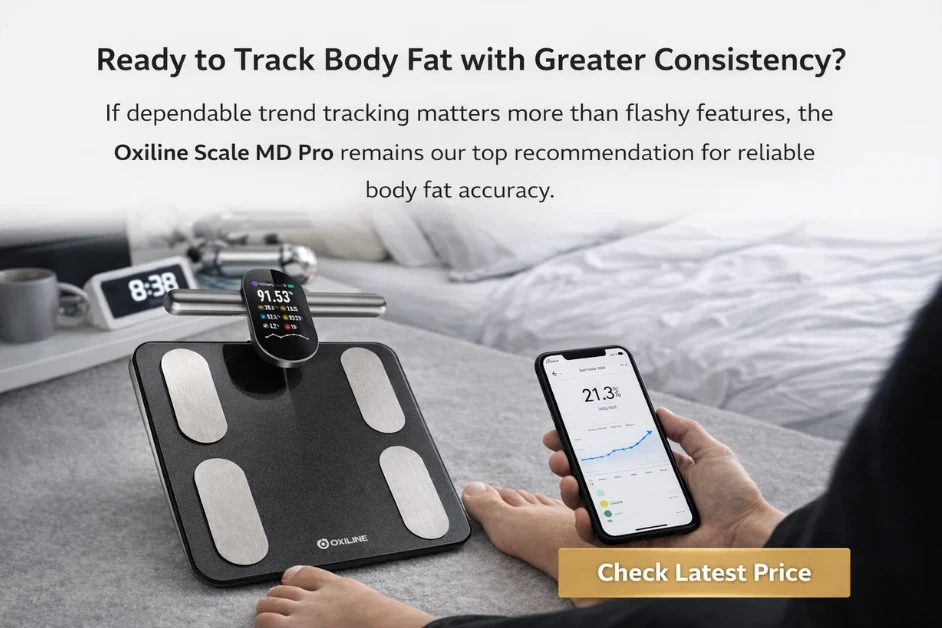
If you’re ready to track your body fat with greater consistency, explore the Oxiline Scale MD Pro below.
Thanks for reading, we look forward to your visit at EliteHealthAffiliates.com – Your Go-To Authority for Health & Wellness