
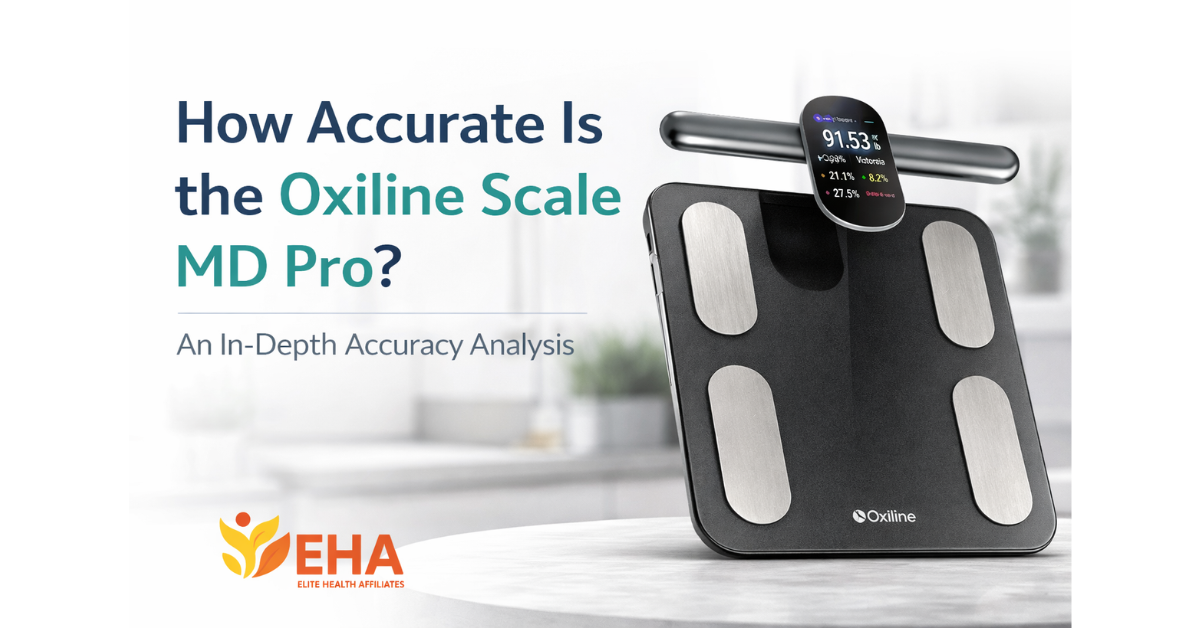
When researching Oxiline Scale MD Pro accuracy, one concern becomes clear almost immediately: Is the Oxiline Scale MD Pro accurate enough to trust for real health tracking? With 31 body composition metrics — including body fat percentage, visceral fat, muscle mass, and metabolic age — the scale promises advanced insight. But features alone don’t determine value. Accuracy does.
Before relying on any smart scale, it’s important to understand how bioelectrical impedance technology (BIA) works, what affects measurement precision, and how consumer devices compare to clinical methods like DEXA scans.
In this guide, we’ll break down what the Oxiline Scale MD Pro can realistically measure, where it performs well, and where expectations should remain grounded.
This post contains affiliate links. If you purchase through them, we may earn a small commission at no extra cost to you.
Table of Contents
Is the Oxiline Scale MD Pro Accurate? (Short Answer)
Short answer: Yes — the Oxiline Scale MD Pro is generally accurate for tracking body composition trends over time, but it is not as precise as clinical testing methods.
The scale uses bioelectrical impedance analysis (BIA) to estimate metrics like body fat percentage, muscle mass, and visceral fat levels. When measurements are taken consistently — under similar hydration levels and at the same time of day — the data tends to be directionally reliable, meaning it accurately reflects progress and changes.
However, factors like hydration, recent exercise, food intake, and time of day can affect individual readings. And while the Oxiline Scale MD Pro performs well for home tracking, it does not match the precision of a DEXA scan or other medical-grade assessments.
For most users, the value lies in consistent trend monitoring, not single-day precision.
How the Oxiline Scale MD Pro Measures Body Composition
The Oxiline Scale MD Pro uses bioelectrical impedance analysis (BIA) to estimate body composition.
BIA works by sending a safe, low-level electrical signal through the body via sensors on the scale’s surface. Because fat tissue, muscle, and water conduct electricity differently, the device measures resistance (impedance) and uses algorithms to estimate metrics like:
- Body fat percentage
- Visceral fat levels
- Muscle mass
- Total body water
- Bone mass
- Metabolic age
Muscle contains more water and conducts electricity more efficiently than fat. Fat tissue resists electrical flow more than lean tissue. By measuring that resistance and combining it with personal inputs like age, height, weight, and gender, the scale generates estimated body composition values.
It’s important to understand that BIA does not directly measure body fat. Instead, it calculates estimates based on electrical resistance patterns and predictive modeling.
That’s why consistency matters.
When readings are taken under similar conditions — ideally in the morning, before eating, and properly hydrated — smart scales like the Oxiline Scale MD Pro can provide reliable trend data over time.
How We Evaluated the Oxiline Scale MD Pro (Observed Use Under RN Guidance)
To better understand Oxiline Scale MD Pro accuracy, we evaluated the scale through structured, real-world use under registered nurse (RN) guidance.
Rather than attempting clinical validation, our focus was on:
- Measurement consistency over time
- The impact of hydration and timing
- Repeat-reading stability within short intervals
- How body fat and visceral fat trends responded to expected lifestyle changes
Measurements were taken under similar conditions — primarily in the morning, before food intake, and with consistent hydration levels — to reduce unnecessary variability.
This approach allowed us to observe whether the scale produced stable, trend-aligned data, which is ultimately more important than single-day precision for most home users.
What We Observed
Across multiple sessions, readings remained directionally consistent when testing conditions were controlled.
When hydration levels varied, body fat percentages shifted slightly — reinforcing what we know about bioelectrical impedance analysis (BIA) sensitivity to water balance. However, under consistent conditions, repeated measurements produced only minor fluctuations.
Most notably, longer-term trends in body fat and weight aligned with expected lifestyle changes, supporting the scale’s reliability for progress tracking rather than diagnostic measurement.
Oxiline Scale MD Pro vs DEXA Scan: How Do They Compare?
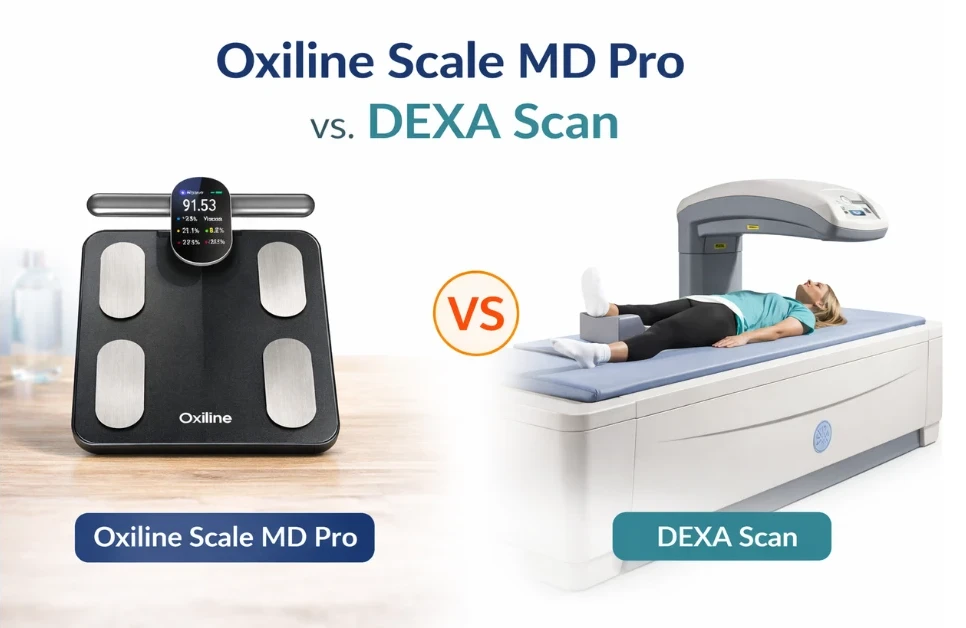
To properly evaluate Oxiline Scale MD Pro accuracy, it helps to compare it with one of the most recognized clinical standards: the DEXA scan (Dual-Energy X-ray Absorptiometry).
A DEXA scan directly measures body composition using low-dose X-ray imaging. It can differentiate between fat mass, lean mass, and bone mass with high precision and is commonly used in medical and research settings.
The Oxiline Scale MD Pro, by contrast, uses bioelectrical impedance analysis (BIA) — an estimation method based on electrical resistance and predictive algorithms.
Here’s the key difference:
- DEXA measures tissue composition directly.
- BIA estimates body composition indirectly.
Because of that, DEXA scans are typically more precise for single-point accuracy. However, they are also:
- Expensive
- Inconvenient
- Not practical for frequent tracking
The Oxiline Scale MD Pro is designed for accessible, repeatable home monitoring. While it may not match DEXA’s clinical precision, it offers something DEXA cannot:
Frequent trend tracking without cost or scheduling barriers.
For most users, consistent weekly or daily trend monitoring provides more actionable insight than a single high-precision scan taken months apart.
The important distinction is this:
- If you need medical-grade body composition assessment, a DEXA scan is superior.
- If you want ongoing progress tracking at home, a well-used smart scale like the Oxiline Scale MD Pro can be highly effective.
Who Should Trust the Oxiline Scale MD Pro — and Who Shouldn’t?
Understanding Oxiline Scale MD Pro accuracy ultimately comes down to expectations.
Who It’s Well-Suited For
The Oxiline Scale MD Pro is a strong fit for individuals who:
- Want to track body fat trends over time
- Prefer frequent at-home monitoring
- Are focused on progress tracking rather than medical diagnosis
- Understand that smart scale readings are estimates
- Can measure consistently (same time of day, similar hydration levels)
For these users, the scale provides useful, directionally reliable data that helps monitor weight changes, body composition shifts, and long-term fitness progress.
When used properly, it becomes a trend analysis tool, not a single-reading decision device.
Who Should Look Elsewhere
The Oxiline Scale MD Pro may not be ideal for those who:
- Require medical-grade precision
- Need body composition data for clinical decision-making
- Expect exact alignment with DEXA scan measurements
- Are unwilling to control for hydration and timing variables
In these cases, a DEXA scan or physician-administered assessment would provide more precise data.
The Bottom Line
The Oxiline Scale MD Pro is not a diagnostic instrument — and it shouldn’t be treated as one.
But for consistent, home-based progress tracking, it performs within the realistic expectations of modern bioelectrical impedance smart scales.
Accuracy, in this context, is about trend reliability, not laboratory-level precision.
Pros and Cons of the Oxiline Scale MD Pro
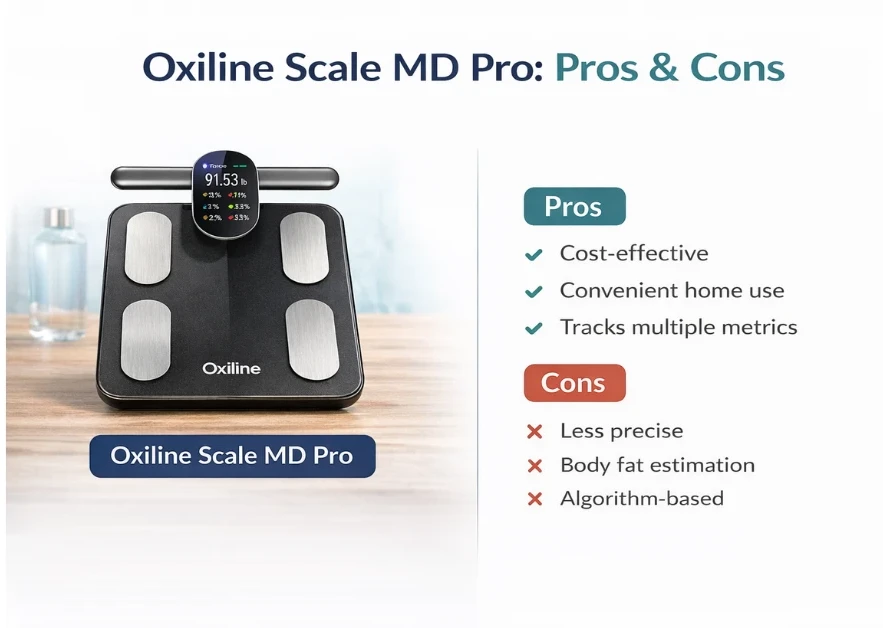
✅ Pros
- Strong Trend Tracking: Provides reliable directionality over time when measurements are taken consistently.
- 31 Metrics: Offers more data points than many consumer smart scales, including visceral fat and metabolic age.
- Easy Home Use: Simple setup and quick readings make it convenient for frequent monitoring.
- Motivation & Awareness: Helps users stay engaged with goals by visualizing progress trends.
- RN-Informed Insights: Our observed-use evaluation under RN guidance supports real-world consistency.
❌ Cons
- Not Clinical Precision: Does not match the accuracy of medical-grade methods like DEXA scans.
- BIA Sensitivity: Hydration, meals, time of day, and recent activity can affect individual readings.
- Estimates Only: Metrics are predictive estimates, not direct measurements.
- Requires Consistency: Best results come from disciplined measurement routines — otherwise data can be noisy.
Quick Summary
If you want trend direction and progress visibility, the Oxiline Scale MD Pro delivers well within the realistic boundaries of consumer BIA technology.
If you want clinical-level precision or exact single-point measurements, it’s not designed for that purpose.
If you’re comparing multiple options beyond just the Oxiline Scale MD Pro, we’ve also published a broader guide on the best smart scales for body fat accuracy that highlights top-performing models and what actually matters in real-world tracking.
Frequently Asked Questions About Oxiline Scale MD Pro Accuracy
How often should you use the Oxiline Scale MD Pro for accurate tracking?
For the most reliable trend data, measure once daily or a few times per week under consistent conditions. The best time is typically in the morning, before eating or drinking, and after using the restroom. Consistency matters more than frequency. Taking measurements at the same time of day helps reduce BIA variability.
Does hydration affect Oxiline Scale MD Pro accuracy?
Yes. Because the scale uses bioelectrical impedance analysis (BIA), hydration levels can influence readings. Higher water levels may slightly lower body fat estimates, while dehydration may increase them. Maintaining similar hydration patterns during each measurement improves reliability.
Can the Oxiline Scale MD Pro accurately measure visceral fat?
The scale estimates visceral fat using predictive algorithms based on electrical resistance patterns. While it does not directly measure visceral fat like imaging tests, it can provide useful trend insight over time. It should be viewed as a monitoring tool, not a diagnostic device.
Is the Oxiline Scale MD Pro as accurate as a DEXA scan?
No. A DEXA scan directly measures tissue composition, making it more precise for single-point assessment. However, the Oxiline Scale MD Pro offers convenient, repeatable at-home tracking, which can be more practical for ongoing progress monitoring.
Why does my body fat percentage change daily?
Daily fluctuations are normal. Factors such as hydration, sodium intake, carbohydrate levels, exercise, and time of day can influence impedance readings. What matters most is the long-term trend, not isolated daily changes.
Learn More About the Oxiline Scale MD Pro
If you’d like a deeper look at real-world usability, app integration, and a complete feature breakdown, read our full Oxiline Scale MD Pro review for a comprehensive evaluation.
For readers who want to review detailed specifications or check current availability directly, you can also view the official product listing on the manufacturer’s site.

Final Verdict on Oxiline Scale MD Pro Accuracy
When evaluating Oxiline Scale MD Pro accuracy, the most important distinction is between clinical precision and practical trend tracking.
The Oxiline Scale MD Pro does not replace a DEXA scan or medical-grade body composition assessment. It uses bioelectrical impedance analysis (BIA), which provides estimated values influenced by hydration, timing, and other variables.
However, when used consistently under similar conditions, it delivers directionally reliable trend data that can be highly valuable for long-term progress monitoring.
For most users, the real strength of this scale is not single-day exactness — it’s the ability to track body fat trends, weight changes, and composition shifts over time without costly clinical appointments.
Used with realistic expectations, the Oxiline Scale MD Pro performs well within the normal limits of modern smart scale technology.
Thanks for visiting, we look forward to your visit at EliteHealthAffiliates.com – Your Go-To Authority for Health & Wellness