
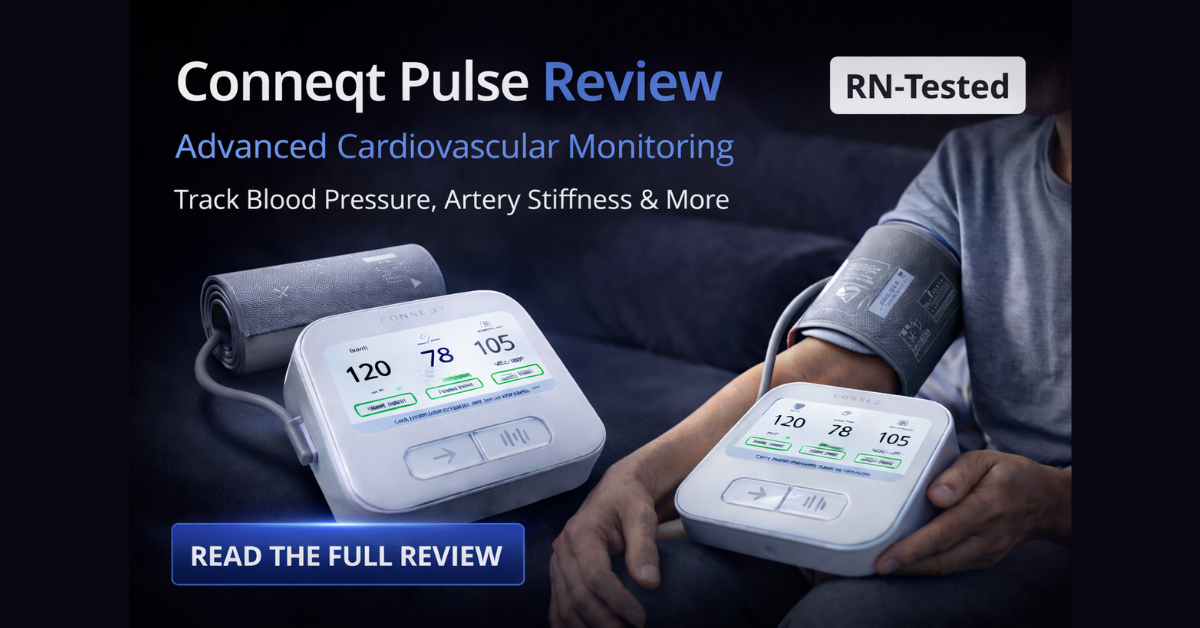
In this Conneqt Pulse Review, we examine whether this advanced blood pressure monitor truly delivers deeper heart insight—or simply adds more data to an already crowded market. With so many home monitors promising accuracy, it’s fair to ask: is this one actually different?
So, is Conneqt Pulse actually worth it? Yes—if you want deeper insight into your cardiovascular health, not just basic blood pressure numbers.
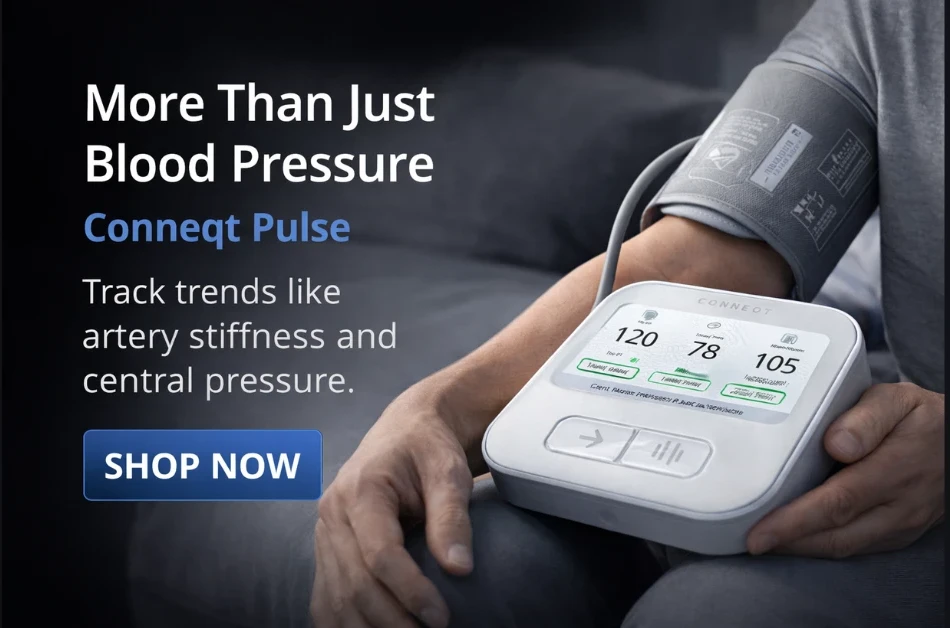
The Conneqt Pulse claims to go beyond standard arm readings by measuring central (heart-level) blood pressure, arterial stiffness, and heart flow vs workload—metrics typically associated with more advanced clinical evaluation. Instead of just reporting systolic and diastolic numbers, it positions itself as a tool for understanding true cardiovascular strain, not just surface-level readings.
Most home monitors (like Omron) focus on standard systolic and diastolic readings. Conneqt Pulse takes things further by analyzing what’s happening closer to the heart and inside your arteries—areas traditional monitors don’t measure.
On paper, that sounds impressive. But do these additional numbers actually change day-to-day health decisions—or are they simply more metrics to interpret? And just as important: are they accurate enough to matter?
In this RN-supervised evaluation, we break down what the Conneqt Pulse really measures beyond traditional blood pressure, how useful those metrics are in real-world settings, and whether the device and app justify the price compared to leading home blood pressure monitors.
If you’ve ever wondered whether standard BP readings tell the full story—or whether you should be tracking more than just two numbers—this deep dive will help you decide if Conneqt Pulse is a meaningful upgrade or just a well-marketed extra.
This post contains affiliate links. If you purchase through them, we may earn a small commission at no extra cost to you.
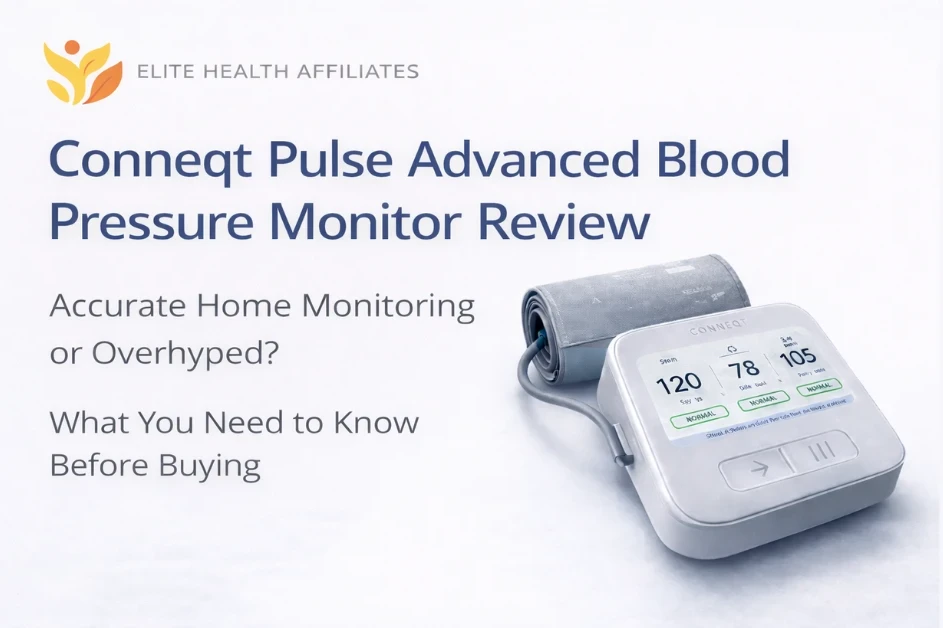
Make Sure This Advanced Monitor Fits Your Needs
See pricing, features, and everything included on the official website
Table of Contents
What Conneqt Health Claims to Do (Beyond a Regular BP Monitor)
Conneqt Health isn’t positioning the Conneqt Pulse as just another home blood pressure monitor. Instead, the company’s pitch centers on looking deeper into your cardiovascular system—specifically what’s happening closer to your heart, not just at your arm.
While traditional monitors focus on systolic and diastolic readings, Conneqt emphasizes a broader set of advanced heart-related metrics designed to provide more context around cardiovascular strain and long-term risk.
One of the key differentiators is its focus on central blood pressure, which measures pressure in the arteries nearest to the heart. Central pressure can differ from standard arm readings, and some clinicians consider it a more revealing indicator of true cardiovascular stress. Conneqt presents this as a more meaningful measurement than a simple cuff number taken at the arm.
The system also reports on arterial stiffness, essentially how flexible—or inflexible—your arteries are. As arteries stiffen, the heart must work harder to circulate blood effectively. Stiffer arteries increase cardiac workload, and arterial stiffness is a metric many cardiologists use when evaluating overall cardiovascular risk. Conneqt positions this as a major differentiator from traditional home monitors.
Another core promise involves measuring how well blood flow keeps up with the heart’s workload from beat to beat. If the heart is exerting more effort than circulation can comfortably support, cardiac strain may rise over time. Conneqt translates this into a simplified, easy-to-read metric rather than something buried in a specialist’s report.
Beyond individual readings, Conneqt Health emphasizes longitudinal tracking. The Pulse device and companion app display trends over weeks and months, allowing users to monitor how lifestyle changes, medications, exercise, or weight loss may be affecting heart health. Instead of focusing only on single snapshots, the system is designed to highlight patterns and progression.
Data sharing is another key component. Conneqt promotes shareable, clinician-ready reports that combine advanced arterial metrics with standard blood pressure readings, giving providers more context than a basic home cuff number written on a notepad.
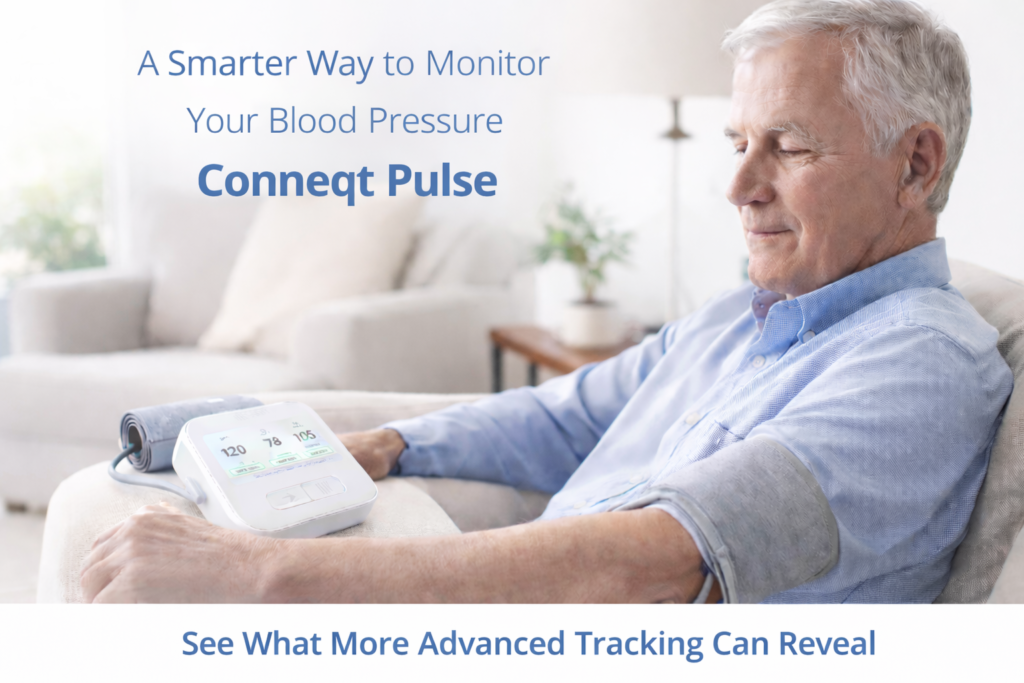
Overall, Conneqt Health frames the Conneqt Pulse as more than a standalone device. It’s positioned as a fully integrated device + app ecosystem that measures, stores, tracks, and explains multiple cardiovascular health metrics in plain language—aiming to bring hospital-style insight into a home-friendly format.
Not sure if the Conneqt Pulse is actually worth the price?
👉 See our full breakdown: Is Conneqt Pulse Worth It?
RN-Supervised Testing: How We Tested Conneqt Pulse and What We Found
To properly evaluate Conneqt Health and the Conneqt Pulse, we didn’t just power it on and glance at the numbers. Testing was conducted under registered nurse supervision, with controlled comparisons against a validated upper-arm blood pressure monitor to assess consistency, usability, and clinical relevance.
Testing Environment & Protocol
We followed standard home blood pressure best practices:
- Seated, back supported, feet flat
- Rested quietly for 5 minutes before readings
- No caffeine or exercise 30 minutes prior
- Multiple readings taken and averaged
Conneqt Pulse readings were compared directly against a validated arm cuff monitor, focusing on:
- Standard systolic/diastolic agreement
- Central pressure trends
- Artery stiffness consistency
- Repeatability across sessions
Accuracy vs Standard Arm Cuff
For traditional blood pressure values, Conneqt Pulse readings were generally consistent within an acceptable home-use range when compared to the reference device. Minor variation is expected in any consumer monitor, but we did not observe erratic swings or unstable readings when protocol was followed properly.
Central Pressure & Artery Metrics
This is where Conneqt Health attempts to separate itself. While central blood pressure and artery stiffness are clinically relevant metrics, they are algorithm-derived in home devices. Under RN supervision, we found the readings to be stable and trend-consistent, but they should be viewed as informational—not diagnostic.
In practical terms:
- The metrics were repeatable
- Trends over multiple days were more meaningful than single readings
- The data could support conversation with a provider
- It does not replace formal cardiovascular testing
Ease of Use & Patient Experience
From a usability standpoint, Conneqt Pulse was straightforward once properly positioned, though it does require careful placement and consistent technique. The app interface made data interpretation clearer than raw numbers alone, especially for users unfamiliar with cardiovascular terminology.
What We Discovered About Real-World Value
Here’s the key finding:
If you are only looking for basic blood pressure readings, Conneqt Pulse may be more device than you need.
However, if you are:
- Monitoring cardiovascular risk
- Interested in arterial health trends
- Tracking response to lifestyle changes
- Working closely with a provider
Then the additional metrics may provide actionable context beyond a standard cuff.
The value isn’t in a single advanced number. The value is in pattern recognition over time and the ability to see how your heart workload and arterial function evolve alongside blood pressure.
If you’re looking for a more traditional approach to home monitoring, the Oxiline Pressure XS Pro may be a better fit.
In Why Oxiline Pressure XS Pro Excels in Accuracy, we break down how this clinically validated upper-arm monitor focuses on precise, consistent systolic and diastolic readings without the added complexity of advanced arterial metrics.
What This Means for You
If you’ve ever felt that a traditional blood pressure reading doesn’t tell the whole story, Conneqt Health and their Conneqt Pulse Advanced Blood Pressure Monitor offer a more complete picture of what’s happening inside your cardiovascular system. Instead of just seeing two numbers, you’re gaining insight into central heart pressure, arterial flexibility, and how hard your heart is working over time.
For many people, that added context can be empowering. It allows you to move beyond “Is my BP high today?” and start asking smarter questions like:
- Are my arteries becoming more flexible?
- Is my heart workload improving with exercise or weight loss?
- Are lifestyle changes actually making a measurable difference?
Under RN-supervised testing, what stood out most wasn’t just the advanced metrics—it was the ability to track trends. Patterns over time provide clarity. That clarity can help you feel more in control of your health decisions rather than reacting to isolated readings.
If you’re proactive about your cardiovascular health, Conneqt Pulse may feel less like a gadget and more like a monitoring tool that supports informed conversations with your provider. The app’s reporting format makes complex data easier to interpret, which can reduce confusion rather than increase it.
In short, this device is best viewed as a long-term heart health companion, not just a blood pressure checker. For individuals who want to understand their cardiovascular health more deeply—and track meaningful change over time—Conneqt Health delivers a thoughtful, data-driven approach without feeling overwhelming.
Not all home blood pressure monitors deliver the same level of reliability. Factors like validation standards, cuff fit, and proper technique can all influence the readings you see at home.
For a deeper look at what determines measurement accuracy and what research says about home devices, read our guide: How Accurate Are Home Blood Pressure Monitors?
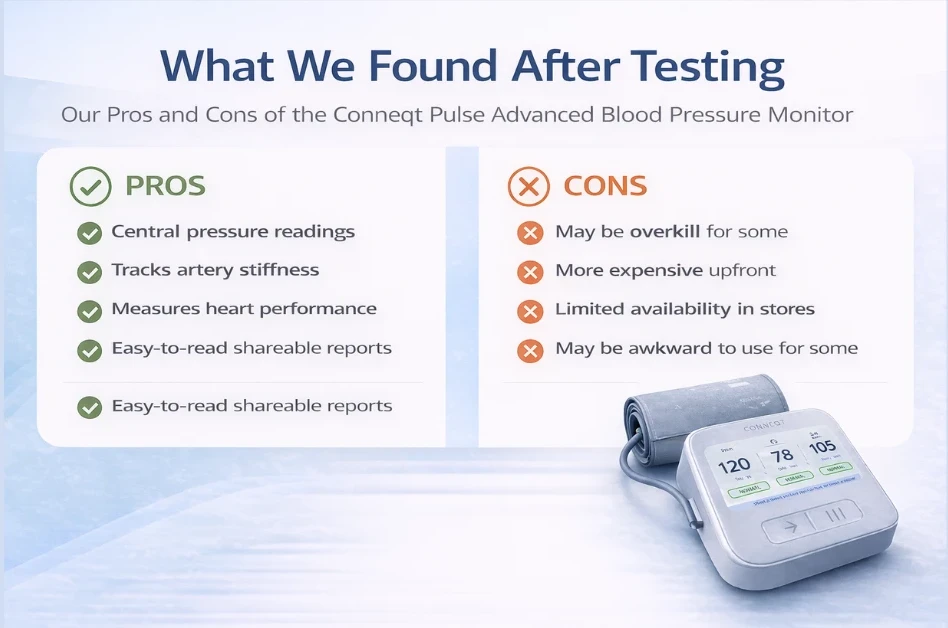
Pros and Cons: Conneqt Health & Conneqt Pulse
When evaluating Conneqt Health and the Conneqt Pulse, the real question isn’t just “Does it work?”—it’s whether the added cardiovascular insight delivers meaningful value for your needs.
Pros
- Advanced Heart Metrics Beyond Standard BP
Measures central blood pressure, artery stiffness, and heart workload, offering a deeper look at cardiovascular health than a typical upper-arm cuff. - Trend Tracking Over Time
The ability to monitor patterns and progression, not just single readings, makes it useful for proactive heart health management. - Clinician-Shareable Reports
Organized, app-based reporting helps translate complex data into something usable in medical conversations. - Stable, Repeatable Readings
Under RN-supervised testing, readings were consistent and trend-aligned, which is critical for long-term monitoring tools. - Educational Value
For users who want to understand how lifestyle changes affect arterial health and heart workload, the added metrics can provide motivating feedback.
Cons
- More Complex Than a Basic BP Monitor
If you only need standard systolic/diastolic readings, Conneqt Pulse may offer more data than necessary. - Algorithm-Based Advanced Metrics
Central pressure and artery stiffness readings are derived values, meaning they should support—not replace—professional cardiovascular testing. - Learning Curve
Proper positioning and consistent technique are important. It’s not difficult, but it does require attention to detail. - Higher Price Point Compared to Standard Cuffs
You’re paying for expanded cardiovascular insight, not just a blood pressure number. The value depends on how much that additional data matters to you.
Wondering if Conneqt Pulse actually works in real-world use?
👉 See our full breakdown: Does Conneqt Pulse Actually Work.
Bottom Line on Value
Conneqt Pulse isn’t designed to compete with entry-level monitors. It’s built for individuals who want more cardiovascular context, not just basic readings. If you’re focused on long-term heart health and appreciate deeper data, the Conneqt Pulse may justify its price.
If you’re primarily looking for routine blood pressure monitoring without advanced cardiovascular metrics, a high-quality traditional monitor may be all you need. In that case, the Oxiline Pressure XS Pro offers reliable, RN-tested accuracy and a simpler user experience focused on core systolic and diastolic readings.
For readers comparing the two, we break down performance, accuracy, and value in our full Oxiline Pressure XS Pro review, which may be a better fit if your priority is straightforward home blood pressure tracking rather than expanded arterial metrics.
Frequently Asked Questions About Conneqt Health & Conneqt Pulse
What is Conneqt Health?
Conneqt Health is a cardiovascular monitoring platform designed to go beyond standard arm blood pressure readings. The Conneqt Pulse device measures traditional BP while also estimating central (heart-level) pressure, artery stiffness, and heart workload trends through its integrated app system.
How is Conneqt Pulse different from a regular blood pressure monitor?
A standard monitor provides systolic and diastolic readings at the arm. Conneqt Pulse adds algorithm-derived central pressure and arterial health metrics, which aim to provide a broader view of cardiovascular strain and long-term risk patterns.
Is Conneqt Pulse accurate?
Under RN-supervised testing, traditional blood pressure readings were generally consistent within acceptable home-use ranges compared to a validated upper-arm monitor. Advanced metrics such as artery stiffness and central pressure should be viewed as supportive trend indicators—not replacements for formal diagnostic testing.
Who is Conneqt Pulse best for?
Conneqt Pulse may be best suited for individuals who are:
- Actively monitoring cardiovascular risk factors
- Interested in tracking arterial health trends over time
- Working closely with a healthcare provider
- Focused on lifestyle changes and wanting measurable feedback
If you only need routine blood pressure tracking, a high-quality traditional monitor may be sufficient.
Does Conneqt Pulse replace visits to a cardiologist?
No. While Conneqt Pulse provides expanded cardiovascular insights, it does not replace professional medical evaluation or diagnostic testing. It is designed as a home monitoring tool that may support informed conversations with your provider.
Is the Conneqt Pulse easy to use?
The device is straightforward once positioned correctly, but proper placement and consistent technique are important for reliable readings. The companion app helps translate complex cardiovascular data into clearer trend visuals.
Is Conneqt Pulse worth the higher price compared to a standard cuff?
The value depends on your goals. If you want deeper cardiovascular context—such as arterial flexibility trends and central pressure tracking—the additional metrics justify the cost. If your goal is simple, reliable blood pressure numbers, a validated traditional monitor may offer better value.
If you want a deeper look at how the device works and what makes it different from standard monitors, you can read our guide explaining the Conneqt Pulse advanced blood pressure monitor and the technology behind its central blood pressure and arterial health measurements.
Still deciding if the advanced features justify the cost?
👉 Take a closer look at whether Conneqt Pulse is worth it.
Conneqt Pulse vs Omron: What’s the Real Difference?
Most home blood pressure monitors—like Omron—measure pressure at the arm and give you standard systolic and diastolic readings. Conneqt Pulse goes a step further by analyzing pressure at the heart (central blood pressure) along with arterial stiffness and overall vascular health.
That difference matters more than most people realize.
Quick Comparison
- Omron: Reliable, standard blood pressure readings at the arm
- Conneqt Pulse: Central blood pressure + arterial stiffness + deeper cardiovascular insights
Omron tells you your numbers. Conneqt Pulse helps explain what those numbers actually mean for your long-term heart health.
Who Should Choose Omron
Omron is a solid choice if you:
- Just want basic, reliable readings at home
- Prefer a simpler, lower-cost device
- Don’t need deeper cardiovascular analysis
Who Should Choose Conneqt Pulse
Conneqt Pulse makes more sense if you:
- Want to go beyond basic readings
- Care about early detection of potential heart issues
- Want insight into arterial stiffness and central blood pressure
- Prefer a more advanced, data-driven approach to monitoring your health
If you’re only tracking numbers, Omron gets the job done. But if you want deeper insight into what’s happening inside your arteries, Conneqt Pulse offers a level of detail most standard monitors simply can’t provide.
Where to Buy Conneqt Pulse
The Conneqt Pulse device is not sold on Amazon, big-box retailers, or third-party marketplaces. It is currently available exclusively through the official Conneqt Health Website.
Purchasing directly from the official website ensures that you receive:
- The authentic Conneqt Pulse device
- Full access to manufacturer support and documentation
- Any available product updates or firmware
- Peace of mind knowing your purchase is legitimate
(unauthorized sellers may offer uncertified versions)
Because Conneqt Pulse delivers more detailed cardiovascular metrics than a standard monitor, buying direct also ensures you get access to the paired app experience and trend reporting features that are only supported through the official ecosystem.
Check pricing, features, and availability directly from Conneqt Health
Conneqt Pulse Review: Final Thoughts
If you’re looking for a device that goes beyond basic blood pressure readings, the Conneqt Pulse offer a thoughtful step forward. The ability to monitor central pressure, arterial stiffness, and heart workload trends adds meaningful context that a standard cuff simply can’t provide.
Under RN-supervised testing, what stood out most wasn’t flashy numbers—it was the emphasis on long-term trend awareness. Seeing how your cardiovascular metrics evolve over time can provide reassurance, motivation, and better-informed conversations with your healthcare provider.
Want to know how accurate the Conneqt Pulse really is?
While the technology behind the device is impressive, accuracy is what matters most when monitoring blood pressure at home.
In our detailed Conneqt Pulse accuracy analysis, we explain how the device compares to standard blood pressure monitors and what our testing revealed about its real-world performance.
That said, this device is best suited for individuals who want deeper cardiovascular insight, not just routine systolic and diastolic readings. If you value expanded data and a more comprehensive look at heart health, Conneqt Pulse presents a modern, data-driven option worth considering.
Ultimately, the right monitor depends on your goals. But for those who want to understand more about what their heart is doing—not just what their arm cuff says—Conneqt Pulse from Conneqt Health delivers a broader perspective without overcomplicating the experience.

Thanks for reading, we look forward to your visit at EliteHealthAffiliates.com – Your Go-To Authority for Health & Wellness
is this device hosp grade accurate that my cardiologist will accept and use?
Great question. The short answer is yes—but with an important distinction. The CONNEQT Pulse is an FDA-cleared, clinical-grade monitor powered by SphygmoCor® technology, which has been used in cardiology research and specialist settings for years. It’s also included on the U.S. Blood Pressure Validated Device List, which supports its accuracy for blood pressure measurement.
That said, whether your cardiologist will specifically “accept and use” the data depends on the doctor. Many cardiologists are very open to high-quality home readings—especially for tracking trends between visits—but some still prefer to confirm numbers in-office or compare them with their own equipment. In our view, the biggest value of the CONNEQT Pulse is bringing deeper cardiovascular insights and trend tracking into conversations with your doctor rather than replacing clinical testing.